The Dog That Didn’t Bark
Much activity, little consequence.
A lot appears to have been happening in Westminster since Andy Burnham became Prime Minister. The new leader arrived promising a different sort of government. Policies have been abandoned, spending priorities questioned and relations with Europe cautiously rearranged. A steady trickle of announcements designed to make people feel a little bit better at the edges has kept the machine turning and has been accompanied by likeable bloke-next-door TikToks. PMQs in the House has been followed by “People’s Major Questions” on and for social media.
Reform has acquired enough money to run a medium sized country, while Nigel Farage has endured a succession of stories that might once have been expected to sink most political leaders. Kemi Badenoch has become noticeably more effective in the Commons and more widely appreciated amongst voters. The LibDems have, well, LibDemmed to little effect. The Greens seem to have leapt in to the public imagination and then almost as suddenly virtually disappeared as the notion of measuring national success via mental health metrics became a little too absurd.
However, what has this frenzy of political activity caused? Almost nothing.
Burnham postponed his flagship investment summit so that it could be held outside London – Manchester is SO lovely at this time of year (Mark Kleinman, Sky News, 16th September 2026 “Burnham to delay flagship investment summit until next year.”) The new Chancellor continued the government’s cautious effort to reconnect Britain with useful bits of European economic architecture without reopening the great Brexit argument (Harry Farley, BBC News, 17th September 2026 “Healey to ask EU finance ministers to let UK into Made in Europe scheme.”) Reform contemplated its enormous new bank balance. In the wake of the new PM cheerfully admitting that he didn’t often visit the countryside and felt that DEFRA was the least important government department, tentative signs of The Revenge of Diddly Squat started to appear: the Countryside Alliance launched a 27-point “Rural Reset.”
The electorate has responded to all this excitement with an enormous “meh.”
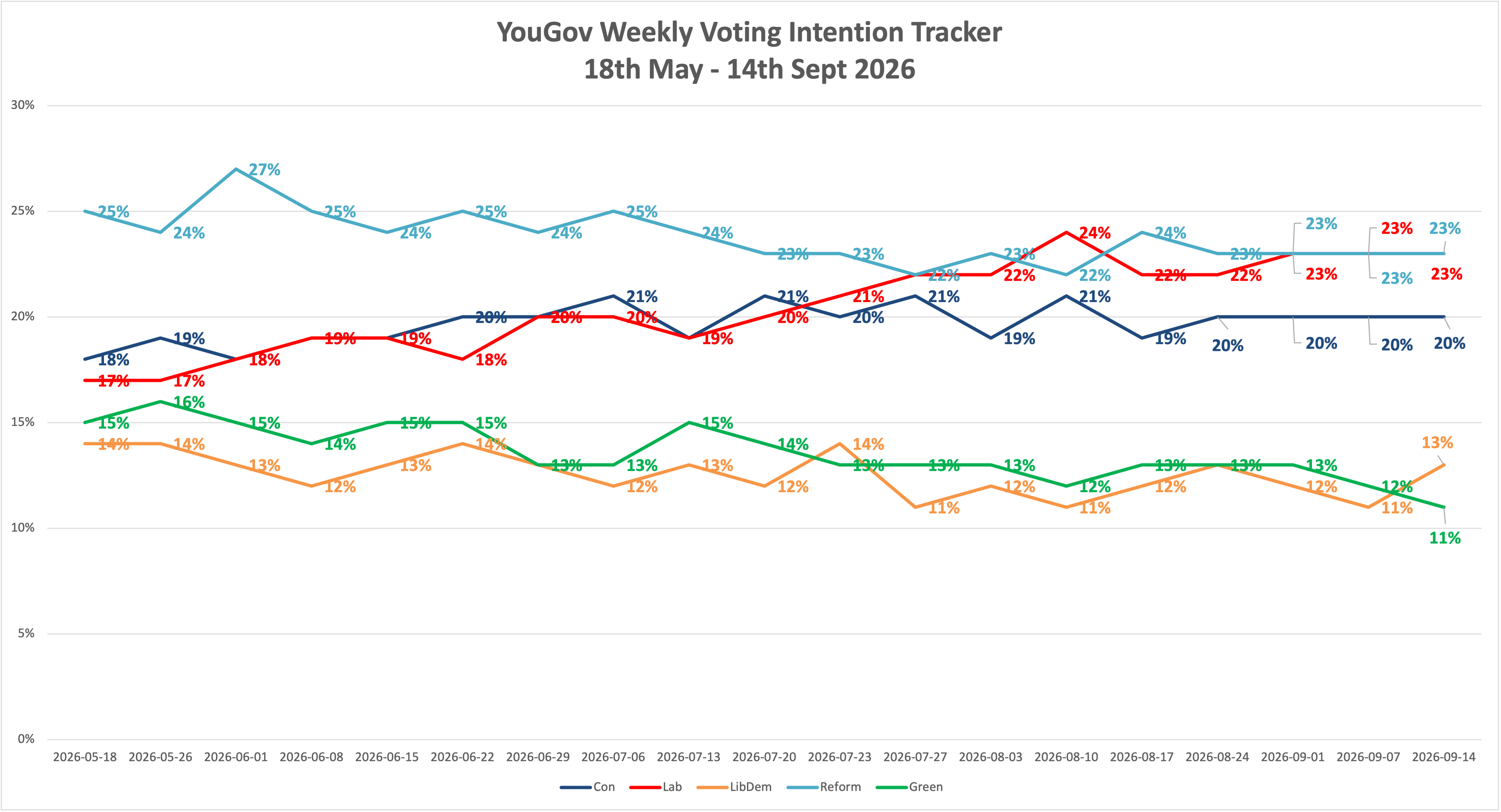
There has been a little week-to-week movement in the party tracker polls since the Burnham anschluß, but nothing that could be called transformative. Labour and Reform remain locked in the mid-20%s, the Conservatives remain behind them and excitable headlines about AI causing the destruction of humanity, Donald Trump having another tantrum, the price of oil trending above $100/barrel, let alone temporarily removing VAT from energy bells, or reducing single bus fares to £2, seem to have almost no discernible effect at all.
The Burnham Bounce Barely Bounced
Burnham is considerably better regarded personally than his principal opponents. Polling consistently finds him ahead of both Farage and Badenoch when voters are asked to compare prospective prime ministers and his personal ratings remain markedly healthier than theirs. One might scorn Tik-Toks about pork scratchings but the King of the North has a natural connection with people in a way that Sir Keir could never aspire to. Nevertheless, Labour has not risen anything like as dramatically as Burnham’s comparative popularity might suggest.
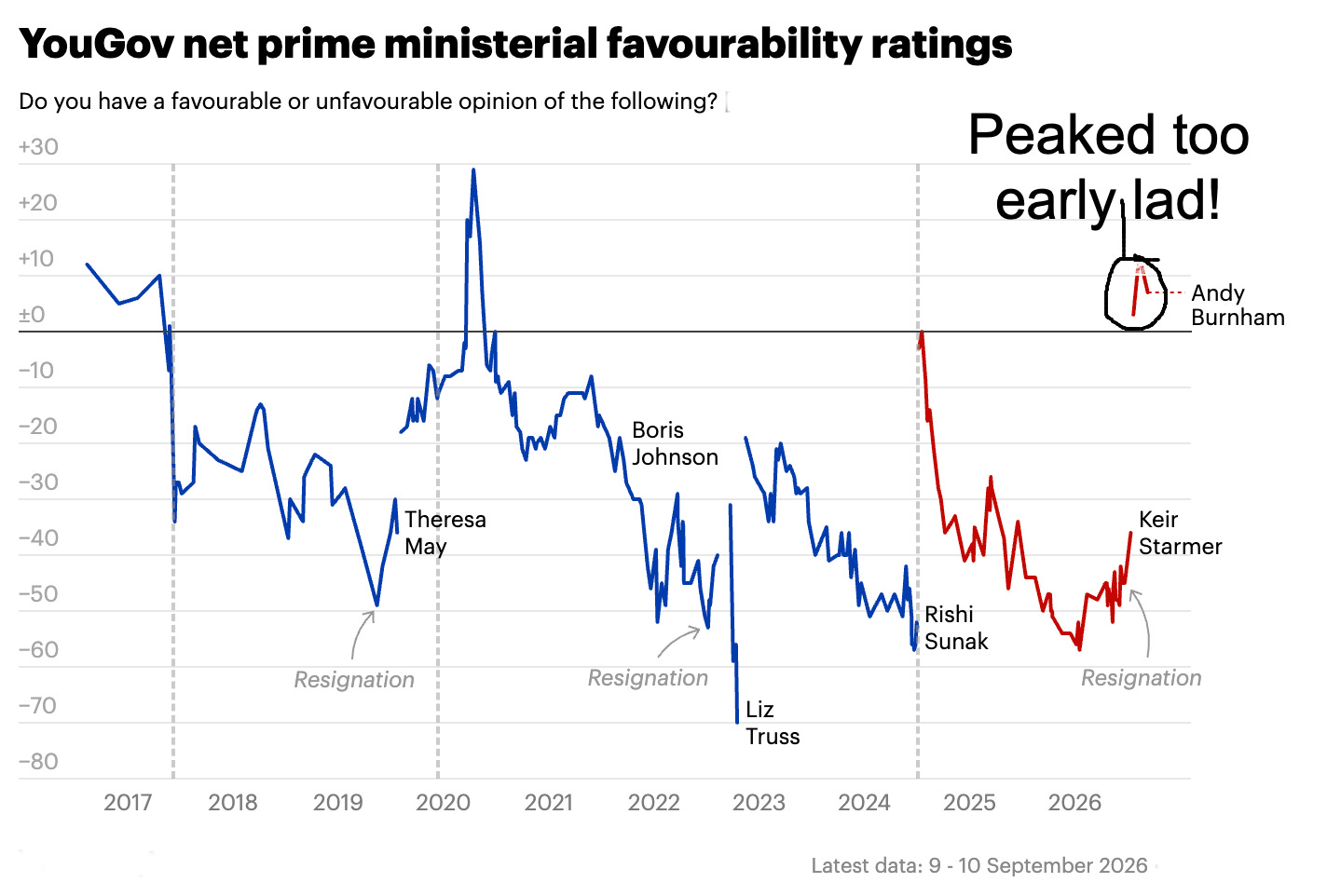
Political parties have spent decades behaving as though leadership is the main variable in electoral politics. The theory goes: change the leader and voters will reconsider the product. Heavens, the Tories have tested this to destruction! But it seems that voters increasingly distinguish between liking a politician and changing their vote.
Burnham is obviously personable. He sounds different from his predecessor. Voters prefer him to Farage when presented with the choice. None of that necessarily means that someone who stopped voting Labour several years ago is ready to return.
The Reform Puzzle
Then there is the more interesting dog: the political litmus paper that is Nigel Farage. Not ever especially popular, he remains viscerally hated by more people than most party leaders. Polling has repeatedly found considerably more people viewing Farage negatively than positively. Recent polls have put Nigel’s net approval firmly underwater, but Reform itself has continued polling in the mid-20%s.
For much of Farage’s political career, conventional analysis has treated him and his parties as essentially interchangeable. UKIP, The Brexit Party and now Reform have always been seen as Farage platforms. While Reform certainly depends on Farage’s impetus, in polling terms Reform continue to float in the mid-20%s despite, rather than because of, Farage.
This does not prove that Reform voters believe every criticism of Farage is a lie. Indeed, voters can hold distinctly unflattering views of Farage while continuing to support his party.
Perhaps the more revealing sentiment is not:
“Nigel is wonderful and they’re all lying about him”
but instead may be:
“Nigel may be flawed, but I’ll vote for Reform anyway.”
This suggests that Reform is beginning to possess something previous Farage vehicles lacked: a political identity capable of existing independently of the reputation of the man who created it.
The MAGA Temptation
British politics is, thankfully, not American politics: Reform is not the Republican Party and Farage is not Donald Trump reincarnated with a pint. The institutions, electorate, political traditions and economies are different.
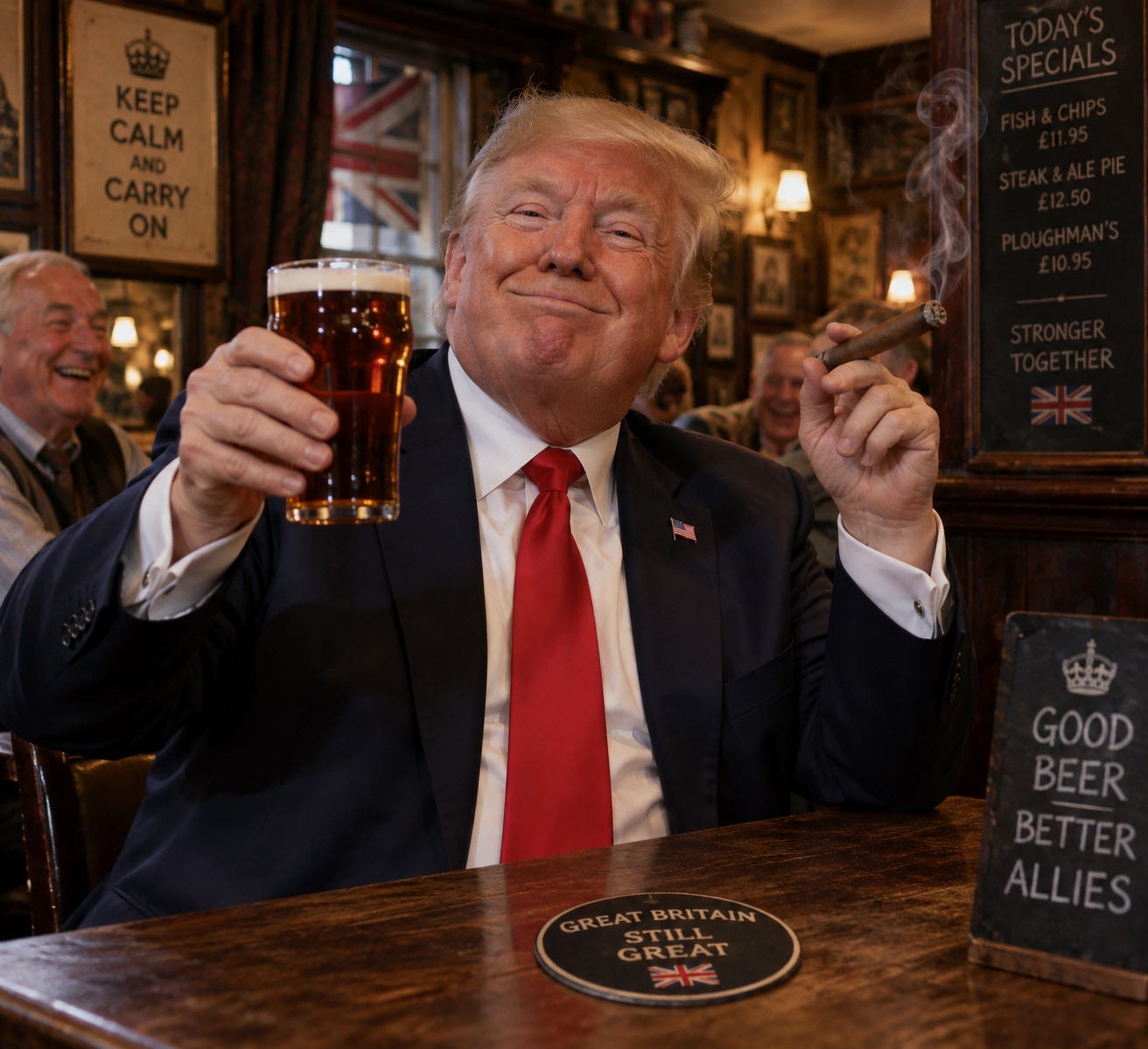
One feature of MAGA politics does seem to have made it across the Atlantic: once political allegiance becomes part of a broader interpretation of the world, conventional political scandals lose their traditional impact.
An accusation no longer necessarily causes the supporter to reconsider the politician. Instead, the source of the accusation is itself incorporated into the political argument.
Recent polling stability suggests that voters inclined to vote for Reform may no longer be voting for Farage, but instead may “just” vote against absolutely everything else.
Badenoch’s Problem
The Conservatives face almost the opposite problem: Kemi Badenoch’s performance has improved both in the Chamber and in public perceptions.
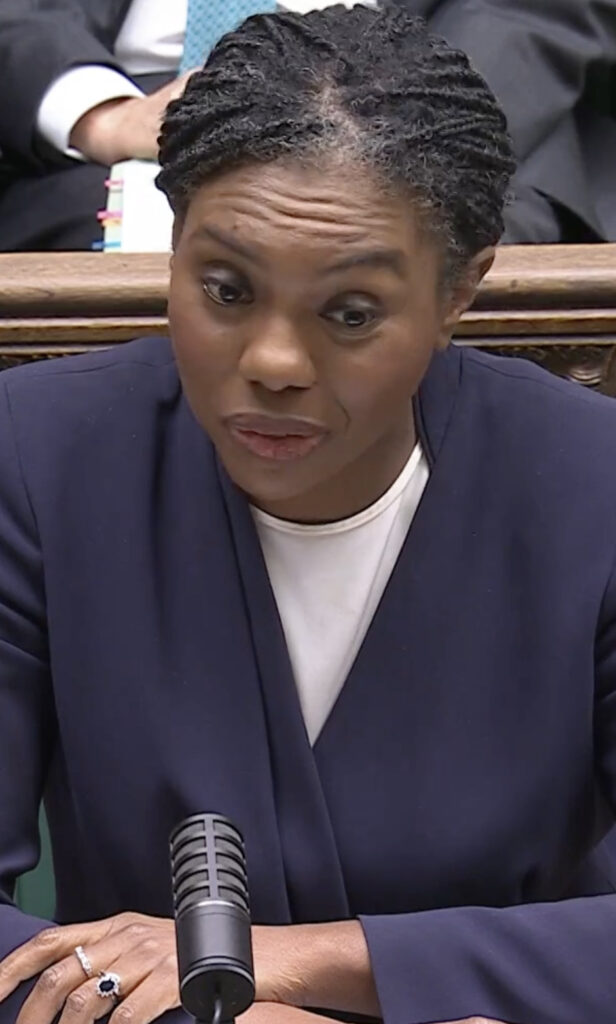
Her Commons performances are sharper. The government now has to defend its decisions and LotO consequently has something solid to attack. She has looked more comfortable doing that and her personal ratings have improved too. Nevertheless, the Conservative vote remains obstinately low.
The Conservatives spent 14 years in government. Not many voters who abandoned them did so because they thought the leader(s) insufficiently effective at PMQs. Improving a leader’s performance cannot immediately repair judgments accumulated over years about immigration, taxation, public services, Brexit, or sheer competence.
Badenoch is likely to continue improving faster than the Conservative brand can recover. This may, at some point, precipitate a difficult conversation with Nigel about some form of electoral pact for the next General Election if it becomes clear that the King of the North may march, with some ease, right through the middle of the Tory and Reform phalanxes.
“Me? Not bovvered mate”
British political opinion has become sticky. Not immutable, or tribal in the old “Aye, we were always tut Labour family” sense. Not permanently fixed, but sticky…
Voters have moved dramatically between parties over the past decade. Some more than twice. The old Labour and Conservative coalitions fractured: Brexit rearranged political loyalties, Reform emerged, the Greens blossomed, the LibDems recovered in slightly eccentric constituencies.
The collapse of traditional party loyalty became a theme. Voters became promiscuous, volatile and willing to switch. Politics fragmented and, perhaps, that fragmentation itself has now created new, if shallow, loyalties. Not necessarily loyalty to parties as institutions, still less to their leaders, but loyalty to political identities: metropolitan progressive, disaffected populist, traditional Conservative, liberal internationalist etc.
If so, Westminster may be misreading the significance of its own daily drama:
- Good PMQs matter
- Disastrous interviews matter
- £36 million donations matter
- Policy reversals matter.
But perhaps these things matter rather less immediately for voting intentions than politicians, journalists and those of us foolish enough to spend Sunday evenings writing about them assume. Voters may simply have stopped listening.
Who Let the Dogs Out?
Some important political things happened, but nothing much moved. Burnham’s popularity has not yet produced a Labour surge. Badenoch’s improvement has not yet produced a Conservative recovery. Farage’s unpopularity has not yet produced a Reform collapse.
The interesting question therefore may not be what did the party leaders do this week, but what do voters now believe that they are voting for, or, more likely, against.
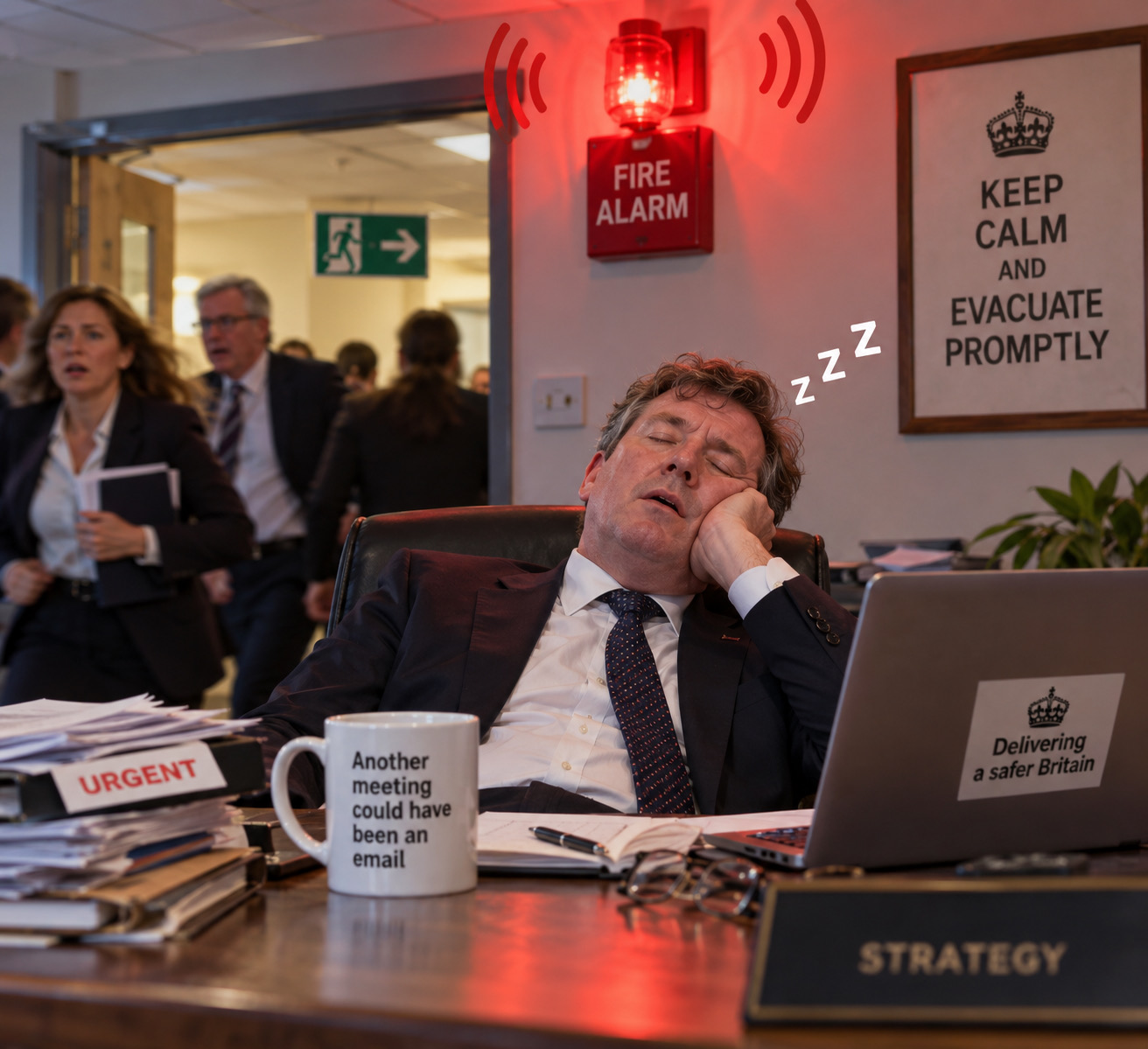
For the moment, Westminster continues barking, but the electorate appears to have concluded that none of it matters very much because nothing will really change, turned over and gone back to sleep.
Check us out on insta @theworldofukpolitics and now at theworldofpolitics.substack.com too!
Leave a Reply
You must be logged in to post a comment.