
POLICY BANK RECOMMENDATIONS
LAND VALUE TAX
Policy idea
To reverse UK’s long-term productivity decline, encourage capital in to productive assets and replace the absurdity of Council Tax and Stamp Duty, initiate a new Land Value Tax.
Problem This Addresses
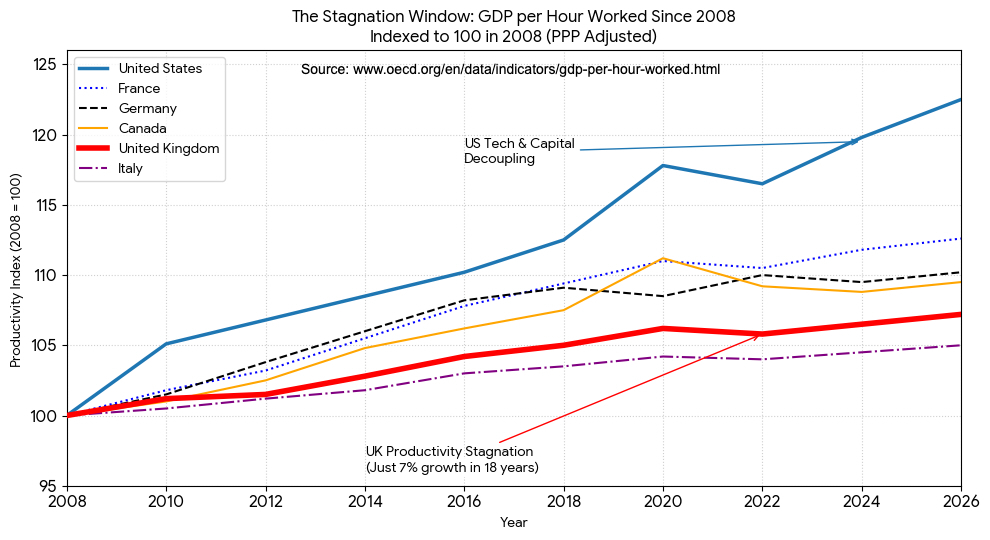
UK growth has been in long-term secular decline and after 30 years of GDP stagnation since the OPEC Oil Price Shock of 1974, the financial crisis of 2008 marked a significant differentiation of the productivity path taken by the USA versus the UK and other G7 economies.
BACKGROUND
Despite the severity of 2008’s financial crisis in the USA, the American economy has harnessed accelerating capital deployment to power an increasing gap in productivity with the other large G7 Western liberal economies. Of the seven nations, UK productivity has lagged all other member nations except Italy. British productivity, measured by GDP per hour worked and indexed by purchasing power parity to compensate for different internal costs and taxes, has become only 7% more productive over the 18 years since 2008, which is only 0.4%pa, and lags US productivity growth by 15% over the entire period or 0.7%pa.
The cause of the UK’s productivity stagnation is not complicated or difficult to diagnose. The UK has invested ~33% less capital in physical and digital productivity enhancers (machinery, software, advanced infrastructure) than the USA over the 18-year period and ~12% less than France, or Germany. (John Van Reenen & Xuyi Yang, The Productivity Institute “Cracking the Productivity Code: An International Comparison of UK Productivity.”)
Historically, capital in the UK economy has been skewed towards land and property, rather than productive assets. Even the wealth generated by the outriders of the Industrial Revolution in the late 18th and 19th centuries was transferred out of manufacturing and in to landed estates dependent on agricultural production and huge properties including a significant component of tenanted accommodation, requiring centuries of dedicated property development and maintenance.
Modern Britain has shown a remarkable tendency to recycle wealth generated in productive sectors back into land ownership. Historic estates remain symbols of success, while rising property values encourage households to devote increasing proportions of their savings to housing rather than productive investment. In the UK, fortunes are recycled in to landed country estates, while the middle classes obsessively refurbish, redecorate and expand their principal store of wealth, rather than investing in new businesses, or expanding existing family enterprises.
The economic case for introducing a land value tax (LVT) in the UK is overwhelming. The need to divert more capital into productive investment and to reduce the incentives for the older generation to gatekeep their capital, almost literally, in an asset that because of its super-return rewards also undercuts attempts to improve the economic participation of their own offspring is urgent, although set against ingrained cultural norms that favour property investment. However, the possible introduction of an LVT involves a potential systemic obstacle: a possible credit collapse caused by reducing the value of the property collateral underlying mortgages and many commercial loans.
Most advocates of LVTs spend little time discussing implementation although the history of Britain’s failed 1909 reforms, together with the structure of modern mortgage finance, suggest that transition is the central policy challenge. This Policy Bank paper therefore focuses less on whether LVT is desirable, than on how an LVT could be introduced safely in the UK finance context.
PROBLEM
The most significant objection to UK LVT proposals does not come from political opponents, but from the history of Lloyd George’s (and Churchill’s !) attempted introduction of a Land Value Tax in the 1909 “People’s Budget.” Their LVT was designed to finance the Liberals’ ambitious social reform programmes, including non-contributory old age pensions and the construction of a fleet of new “Dreadnought” battleships to compete with Germany’s naval expansion. This 1909 iteration of a LVT did not end well and, after causing inter alia a constitutional crisis that ended the House of Lords’ ability to veto finance proposals passed by the Commons, the LVT scheme then only delivered disappointing tax receipts based on a cumbersome valuation process, became subject to almost continuous legal dispute and was itself repealed by the 1920 Finance Act.
However, it is the LVT’s most devoted current economic advocates, including distinguished former Bank of England economist Prof Charles Goodhart CBE, who warn that any abrupt introduction of a new land value tax could trigger a collapse in land values.
“I think the arguments in favour of a land tax are really overwhelming, irrespective of where you stand politically. The advantages are unquestionable. But the problem is getting from A to B. The transitional problems are really quite serious and severe.”
Prof Charles Goodhart, CBE
Fundamentally, because the UK’s credit system treats property as primary collateral, reductions in land value reflecting the prospective taxation of property value increases could morph into a systemic banking crisis.Escaping that fate requires a strategy for the introduction of a tax which would be a crucial step in encouraging the redeployment of British capital towards more productive assets than the eternal obsession with refurbishing the East Wing’s historic servants’ bedrooms as a home cinema suitable for 21st century family life, or the addition of another totally underemployed “garden room.”
PROPOSALS
The introduction of a whole new tax requires care and delicacy. It also requires careful political timing if the systemic preparation and phased introduction required is to be achieved within or across the political cycle. TWOP’s policy recommendation depends on taking six phased action plans:
- Prepare the Banking System
- Adopt Modern Property Valuation Methods
- End Land Banking
- Encourage Development Density
- Protect Owner Occupiers
- Redirect Capital into Productive Investment
1. Prepare the Banking System
Phasing LVT in slowly, by raising it from 0.5% to 2.5% over five years could protect landlords’ cash flow, but this would leave bank collateral dangerously exposed. Financial markets are forward-looking so that the moment a final LVT rate is credibly announced, markets reprice the underlying asset instantly. Defusing the inevitable credit collapse that would follow requires restructuring the banking system two years before implementation:
- Prudential Tightening: The Bank of England must raise affordability stress tests.
- De-leveraging: Lower maximum loan-to-value ratios on all new lending.
- Capital Buffers: Force commercial banks to hold thicker capital cushions against existing mortgage books.
By “Implementation Day” high-risk, low-equity lending should have ceased and vulnerable legacy loans will have paid down, with appropriate discounts, leaving the banking system able to cope with any negative equity consequences and thus, ironically, reducing the potential occurrence of negative equity situations towards zero.
2. Adopt Modern Property Valuation Methods
The fatal flaw of the UK’s 1909 tax was the valuation process it introduced (see the 1910 Finance Act.) Attempting to value the raw land beneath every building in the country invited endless, expensive litigation. Instead, the State must utilise data it already collects: the annual rent landlords declare to HMRC on self-assessment returns for rented property and automated property valuation assessments for owner-occupied homes. Capitalising owner-declared rents using a standard multiple creates an automatic, annual valuation without a single surveyor, or tribunal required.
- Anti-Evasion Mechanism: deploy a classic European fiscal device—a self-assessed tax paired with a state purchase option to prevent landlord evasion or tax-reduction. If a landlord lowballs their rental value to dodge the tax, the state should reserve the right to purchase the property at that implied price or nominate a commercial lender to do so. This must apply strictly to investment properties, but must never be extended to owner-occupied homes.
- Progressive Ratchet: structure the LVT bands so that raising rents pushes landlords into higher tax brackets where the financial penalty outweighs the rental gain. This reverses traditional incentive, cutting rent becomes the landlord’s most profitable move, creating a self-enforcing brake on inflation.
3. End Land Banking
Critics argue that a land tax alone will not spur new housing. To fix this, transform planning permission from a passive asset into a ticking clock. When planning permission is granted, a strict “development window” should be started, during which the developer pays no LVT. Build on time and the site remains tax-free.
- Escalator: if a developer misses their deadlines, an escalating tax penalty should then be triggered. Sitting on undeveloped, “permitted” land would then become ruinous: the LVT activates at the standard rate, multiplying to 1.5x after a project becomes 12 months late and 3x after it is 24 months late.
- Safety Valve: a “stop the clock” clause should pause the LVT escalator for verifiable systemic delays (including delayed utility grid connections or freezing judicial reviews) but if a developer is simply land-banking, they carry the LVT cost alone, which would curtail the last 40 years of speculative land hoarding.
4. Encourage Development Density
Pure LVTs can fail because separating the value of raw land from the bricks on top invites endless legal disputes, but it is possible to avoid this trap entirely. Tax the overall assessed property value instead, then apply a density multiplier to capture the land share.
- Density Multiplier: a detached house occupying a large plot should carry a multiplier of 1.0; mid-rise blocks of flats spread across multiple homes, reducing each property’s multiplier to 0.2; high-rise tower blocks should drop to 0.05.
- Utilisation Lock: implementing a classic “Georgist” incentive (encouragement of density), without conducting a single formal land valuation and to prevent wealthy investors from exploiting low high-rise multipliers to park capital in empty luxury apartments, the multiplier should be based on occupied density, while an aggressive vacancy escalator penalises empty units.
5. Protect Owner Occupiers
The emotional heart of anti-land-tax campaigns is the cash-poor, asset-rich pensioner who cannot afford a new annual tax on their long-time family home (even if it replaces the absurd current regime of Council Tax.) Neutralise this opposition with a targeted demographic phase-in:
- Exemption Cap: immediately exempt all primary residences valued up to £2million. This shields ordinary homeowners while raising substantial revenue from commercial property and luxury investment portfolios. Gradually lower this cap over a decade to £0.5million to phase owner-occupiers in gently.
- Downsizer Incentive: do not simply defer bills until probate, which leaves elderly residents under-occupying large family homes, but instead offer a time-limited Capital Gains Tax holiday for downsizers. Selling a large home to downsize should incur zero tax on the value gain, keeping cash in the downsizers’ pockets, unlocking under-occupied housing stock and in many cases providing potential routes for family capital transitions that could enable younger family members to purchase their own smaller properties.
6. Redirect Capital into Productive Investment
An LVT on its own merely deflates land prices. The goal, however, should not be to punish landowners, but rather, to dislodge parked capital and drive it into productive investment.
Successful LVT introduction must therefore operate alongside a clear economic destination, which means pairing the LVT with:
- National Investment Bank scaled for industrial-scale deployment.
- Zero Capital Gains Tax on domestic, productive industrial investment.
- Energy Infrastructure Program to lower industrial electricity costs significantly.
Beyond the Political Cycle
Policy designers and politicians must honestly confront a severe timing mismatch. The economic pain of LVT introduction will accrue within the first five years of operation, while the rewards of productive investment compound over a decade or more. The guardrails, exemptions and phasing detailed above are not just political concessions, but the steps required to avoid the fate of Lloyd George’s 1909 LVT plan.
Further reading
Henry George: Progress & Poverty (1879)
(PDF of the 50th Anniversary Edition from the Mises Institute.)
Foundational text of “Georgism” explains why poverty persists despite economic progress,
pointing directly to land monopoly and introducing the concept of a land value tax.
Adam Smith: The Wealth of Nations Book V, Ch 2, Pt 2, s1a (1776)
(Helpfully set out PDF via Jonathan Bennett at Early Modern Texts.)
The original and still the best: Smith famously notes that a tax on land rents cannot
distort economic behaviour, or discourage industry, laying the earliest free-market groundwork for LVT.
John Muellbauer: Why we need a green land value tax and how to design it
Oxford Institute for Economic Policy, 2023 in OECD Fiscal Federalism Studies 2023
Updates LVT for modern climate and financial goals, dealing with transition dynamics, property wealth
and the use of modern data automation to avoid historical valuation traps.
Charles Goodhart & Boris Hofmann: House Prices, Money, Credit and the Macroeconomy
ECB Working Paper Series No 888, 2008
Illustrates how modern credit cycles are intimately tied to property collateral.
Mirrlees Review: Tax by Design
Institute for Fiscal Studies, 2011 Chapter 16 “The Taxation of Land and Property.”
Sets out the problems of UK housing and property taxation and argues for the replacement of Council Tax and
Stamp Duty with a Land Value Tax, highlighting how regressive the current 1991 property valuation bands are.
Fairer Share Campaign
The policy vehicle often referenced beneath Andy Burnham’s policy platform models a Proportional Property Tax (PPT)
set at 0.48% for owner-occupiers and thus serves as a contemporary case study on real-world LVT introduction friction.
THESE POLICY RECOMMENDATIONS ARE FIRST DRAFTS. WE WELCOME YOUR COMMENTS AND WE WILL INCORPORATE THESE IN TO IMPROVED POLICY RECOMMENDATIONS. THANK YOU.
Leave a Reply
You must be logged in to post a comment.