
981,000 16–24-year-olds were not in education, employment or training (“NEET”) in the UK in the three months from April to June this year according to the latest ONS figures released on 27th August, That is ONE IN EIGHT young people – nearly 1million beginning adult life without employment, education or training.
This is not a new problem. Governments have worried about youth unemployment, economic inactivity, skills and the transition from education into work for years, but its present scale is extraordinary..

The Government knows this. In January it appointed former Labour Health Secretary, Alan Milburn, to lead an independent review into “Young People and Work”. Its interim diagnostic report appeared in May. The report runs to hundreds of paragraphs examining education, skills, health, welfare and the changing labour market. Its conclusion (para 678) was admirably uncomplicated:
“What is no longer credible is to do nothing.”
The NEET review’s second phase was supposed to identify solutions in September after Parliament returned from its Summer break. Publication has now been delayed until after the Labour Party Conference at the end of September, conveniently avoiding potentially rancorous conference discussion of welfare reform, minimum wage levels, benefits and PIP with the political world’s attention fixed on the new PM.
But never fear, action is on the way! An announcement appeared on Tuesday: Sainsbury’s will provide 10,000 new unpaid work-experience “opportunities” for young people during 2026/27.

Whoop! Whoop! Although there is nothing inherently wrong with this in itself: work experience can be valuable. Employers willing to give young people some experience of the workplace should probably be encouraged to do so.
But these are not 10,000 jobs. They are unpaid work-experience placements. In retail.
Only two days after the Sainsbury’s announcement, ONS told us that 981,000 young people were officially “NEET” in the April-June quarter, which means that if every Sainsbury’s placement went to somebody currently classified as NEET, the scheme would reach 1% of them. Even for that 1%, this provides work experience, not a job.
This is the point at which the distinction between an initiative and a solution becomes important: 10,000 work-experience placements might be a perfectly worthwhile initiative. Presenting them from Downing Street as evidence of a serious national response to a problem affecting almost 1 million young people is very clearly of a very different and insufficient order of magnitude.
The problem is not Sainsbury’s. The problem is scale. And purpose.
The missing first rung
There is a wider problem which is much less amenable to a press release. Britain appears to be becoming less able to move young people from education into work and from work into economic independence.

At the bottom of the labour market the first rung is becoming harder to reach.
The Starmer Government substantially increased the National Living Wage for younger workers. Since April 2024 the rate for under-18s has risen from £6.40 to £8.00 an hour, an increase of 25%. For 18–20-year-olds it has risen from £8.60 to £10.85, an increase of just over 26%.
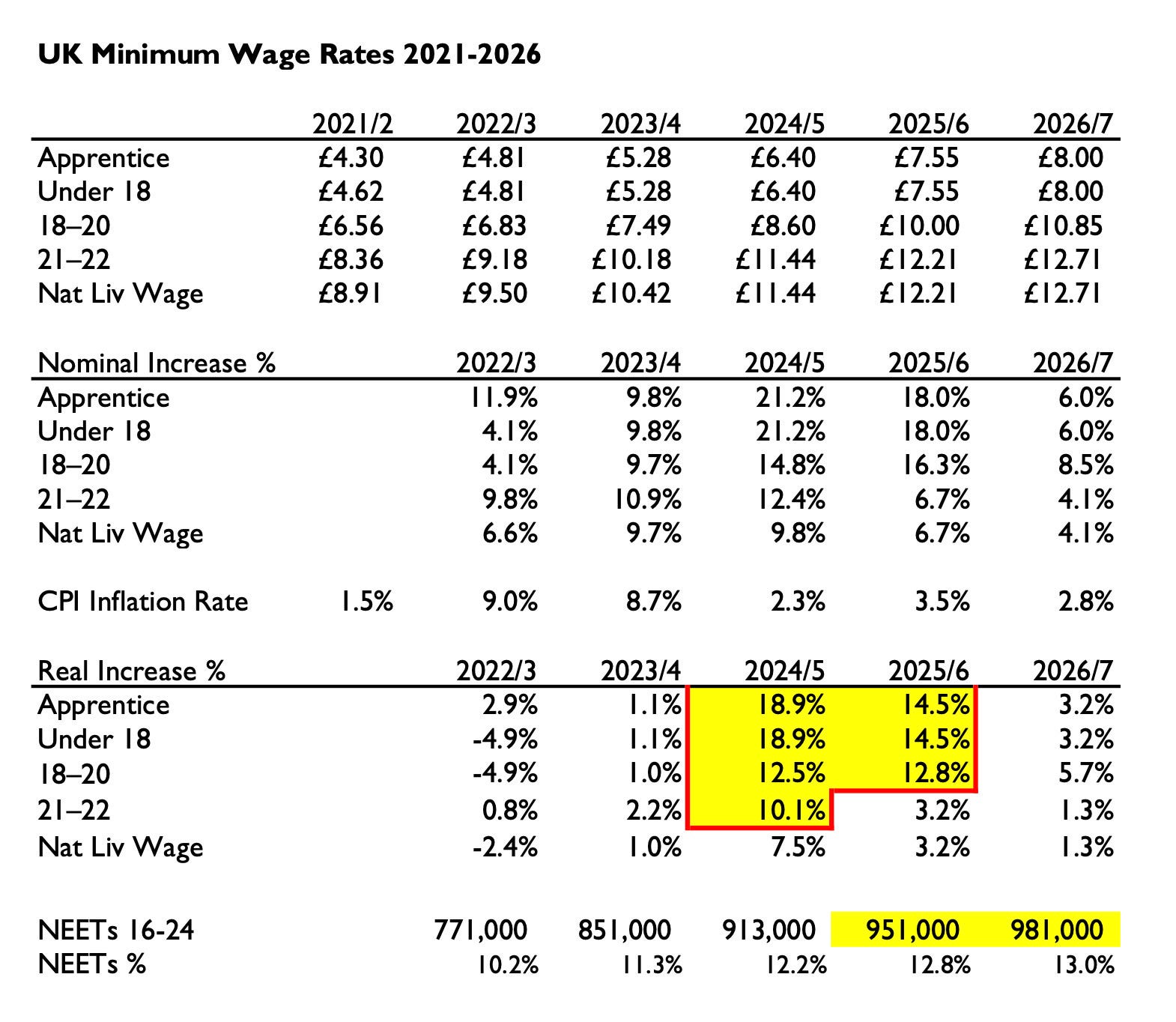
There are perfectly good reasons for wanting younger workers to be paid more, but policy cannot stop at the desirability of the wage received by somebody who already has a job. Government must also consider what happens to the person trying to get their foot on the first rung of the ladder.
If the cost of employing an inexperienced young worker rises rapidly while entry-level vacancies are disappearing, it is reasonable to remark that the first step into employment is obviously becoming harder.
This is not as simple as saying that one tax rise caused youth unemployment. It is significantly more complicated, as Alan Milburn set out in exhaustive detail in his report: education policy, wage policy, taxation, welfare, mental health, skills, employer behaviour and economic growth all interact. However, one must ask whether increasing the cost of employing inexperienced young people so rapidly might not have reduced the attractiveness of taking them on, particularly when entry-level vacancies are already contracting.
Neither is the default panacea of increasing the proportion of 18-year-olds embarking on university careers an escape route or a “solution.” The graduate employment market is as bad as it has ever been (Tim Wallace, Daily Telegraph, 24th August 2026 [PAYWALL] “Graduates face worst jobs market on record.”) Just 8,383 new graduate roles were advertised in July 2026, a 45% reduction on July 2025 and the lowest figure recorded since records were first compiled in 2016. At almost exactly the same moment, a record 263,000 18-year-olds are, even now, preparing to begin new degree courses in September.

UK education policy continues to funnel record numbers of young people towards higher education while the graduate employment market waiting at the other end contracts. Meanwhile, outside that route, nearly 1million young people are not in employment, education or training. It is becoming increasingly difficult to regard these as separate problems. Across very different routes out of education the path into sustained employment appears to be narrowing. 10,000 work-experience placements at Sainsbury’s do not begin to address the problem.
Another report for later
There is an uncomfortable echo elsewhere in government. Sir Stephen Timms published the interim findings of his review of Personal Independence Payments on 9th July. The PIP system, he concluded, was “not fit for purpose.” His terms of reference envisaged the final report appearing in Autumn 2026, but it now appears that “Autumn” means November. Meteorologically, just about true, but politically… November has the considerable advantage of being after the Labour Party Conference and late enough to make major legislation increasingly difficult before 2027 and implementation unlikely before the start of the following academic year in September 2028.
Perhaps both delays can be justified, but a pattern has emerged:
- Government identifies difficult problem.
- Government commissions an expert review.
- Expert discovers that the problem is indeed difficult.
- Solutions threaten difficult political choices.
- Report publication is delayed.
The difficult answer can wait. The easy announcement, it seems, cannot. This is not “governmenting” it is “ducking and diving” or “politics” as some call it.
Elsewhere this week…
Andy Burnham announced that he will abstain when the reintroduced Assisted Dying Bill comes before Parliament on 11th September because he does not want his position as Prime Minister to sway MPs. “I have an opinion but I don’t want to convince anyone” represents a more than slightly curious definition of political leadership. (Ewan Somerville & Kate Whannel, BBC News, 28th August 2026 “Burnham says he will not vote on assisted dying unlike Starmer.”)
John Healey precipitated Starmer’s downfall by resigning as Defence Secretary on 11th June, because “the prime minister had been “unable” and the Treasury “unwilling” to “commit the resources that the nation needs to defend the country.”
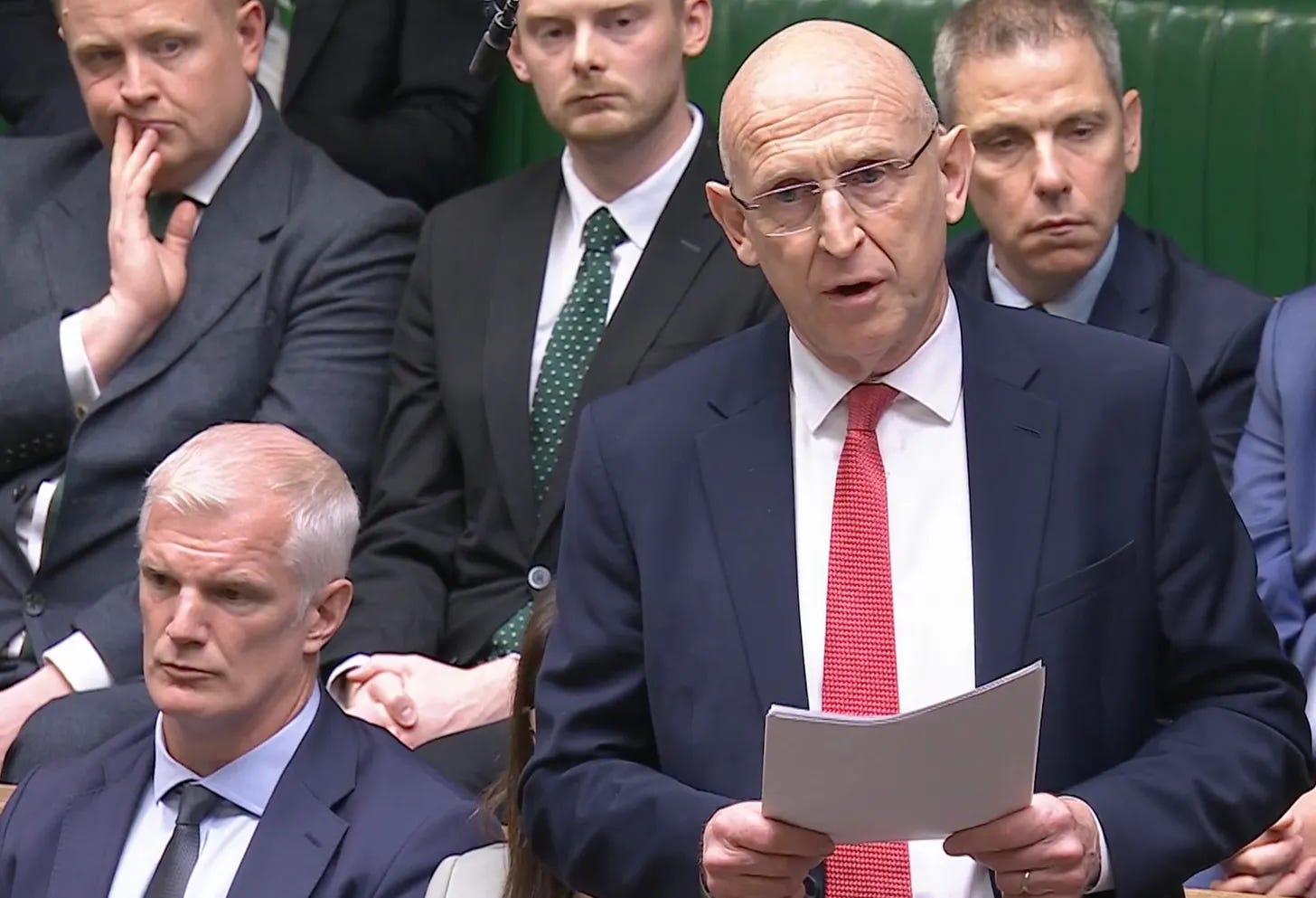
Now, just 11 weeks later, as Andy Burnham’s newly appointed Chancellor, Healey has discovered that his Treasury may also be unwilling to commit the resources as he sets about “rolling the pitch” for delaying making any commitment to reach the 3.0% GDP defence spending target by 2030 until the 2027 spending review. (Heather Stewart & Lauren Almeida, The Guardian, 28th August 2026 “Healey’s budget to duck setting a date for 3% defence spending target.”)
It is remarkable how different the Treasury looks from the other side of the table.
There were other things. Prison releases remain awkward. More than 500 people crossed the Channel in small boats on one day. James Cleverly left the Shadow Cabinet to begin an extraordinarily leisurely process of running for Mayor of London in 2028. Scotland’s First Minister published another draft independence bill defying all conventions, history and OFHS!
This week
This week those stories feel rather less important.
Because 981,000 is quite a difficult number to get past. Nearly 1million young people outside employment, education or training do not need another announcement intended to demonstrate that something is being done. They need someone to work out why the first rung of the ladder has disappeared.
Alan Milburn has been asked to do precisely that.
Perhaps we should hear his answer.
The politics of announcements is winning out over the identification and preparation of solutions
Check us out on insta @theworldofukpolitics and now at theworldofpolitics.substack.com too!
Leave a Reply
You must be logged in to post a comment.