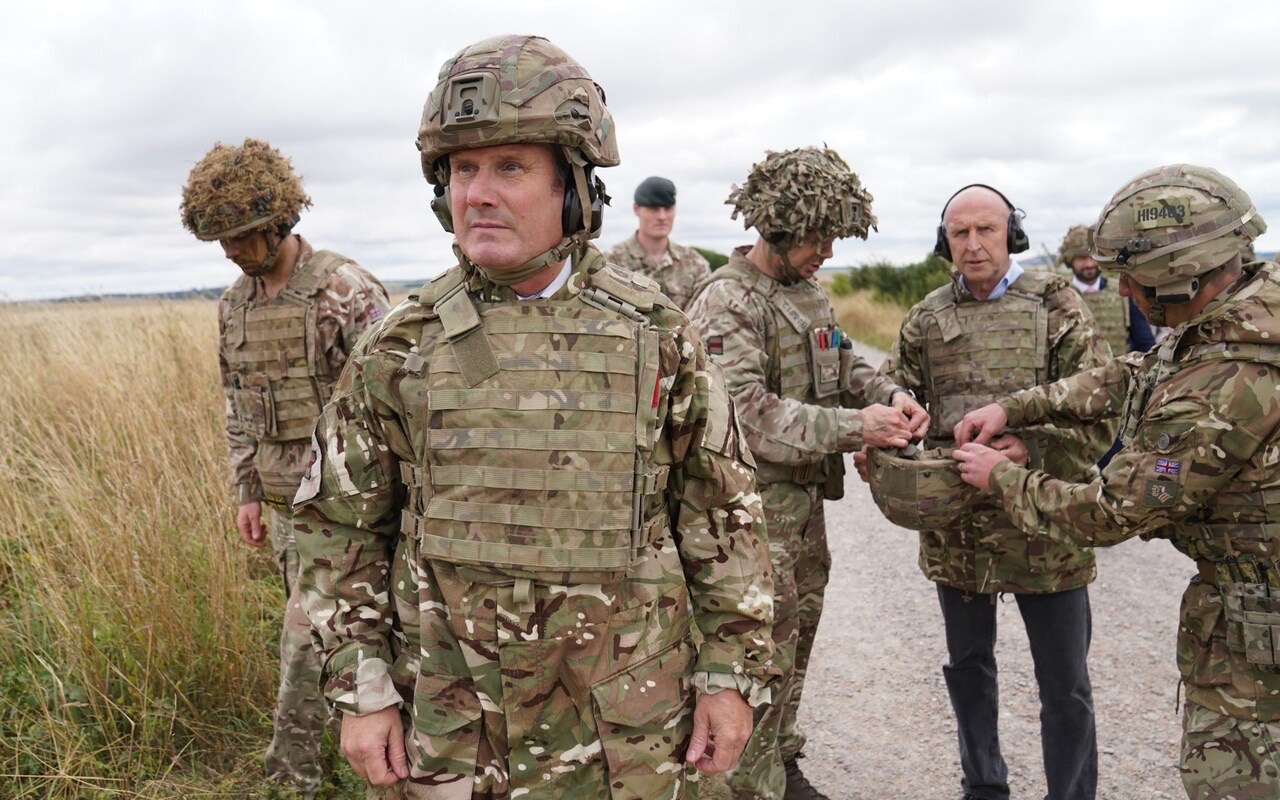
One of the defining characteristics of governments in difficulty is not that they make mistakes. All governments make mistakes. The defining characteristic is panic.
Difficult decisions are postponed. Problems accumulate. Then events force action and politicians rush to demonstrate decisiveness. Whether the resulting policies are effective becomes secondary to the need to appear active.
This week provided several examples. A Defence Secretary resigned after concluding that the Government would not properly fund its own Defence Review. Riots in Belfast reignited arguments over immigration and integration. Ministers accelerated plans for social media restrictions despite only recently concluding a consultation exercise and all the while Westminster’s attention drifted steadily towards Makerfield, where one by-election has acquired the atmosphere of a national referendum on the future of British politics (although the good voters of Makerfield are answering a quite different question than the one election analysts are hoping for answers to.)
Defence: Panic Meets Reality
The biggest political story of the week was not Makerfield but the resignation of Defence Secretary John Healey. Dedicated readers may have noted that TWOP took the unusual decision to go semi-live.
Healey suggested that the final version of the long-delayed Defence Investment Plan, (which he had only been shown the “final” version of on Monday 8th June) demonstrated that the Prime Minister had been unable, and the Treasury unwilling, to commit the resources required to implement the Strategic Defence Review. This is not the language of policy disagreement. It is the language of disappointment and frustration.
The Prime Minister and his Government have repeatedly argued that Britain is undertaking its largest defence expansion since the Cold War.
This argument was on public display in the “emergency” interview No 10 granted a somewhat incredulous Chris Mason for BBC Newscast on Friday 12th June.
TWOP was so struck by the panicked nature of this interview that we produced a transcript just to check whether we are inhabiting the same political dimension as the Prime Minister.
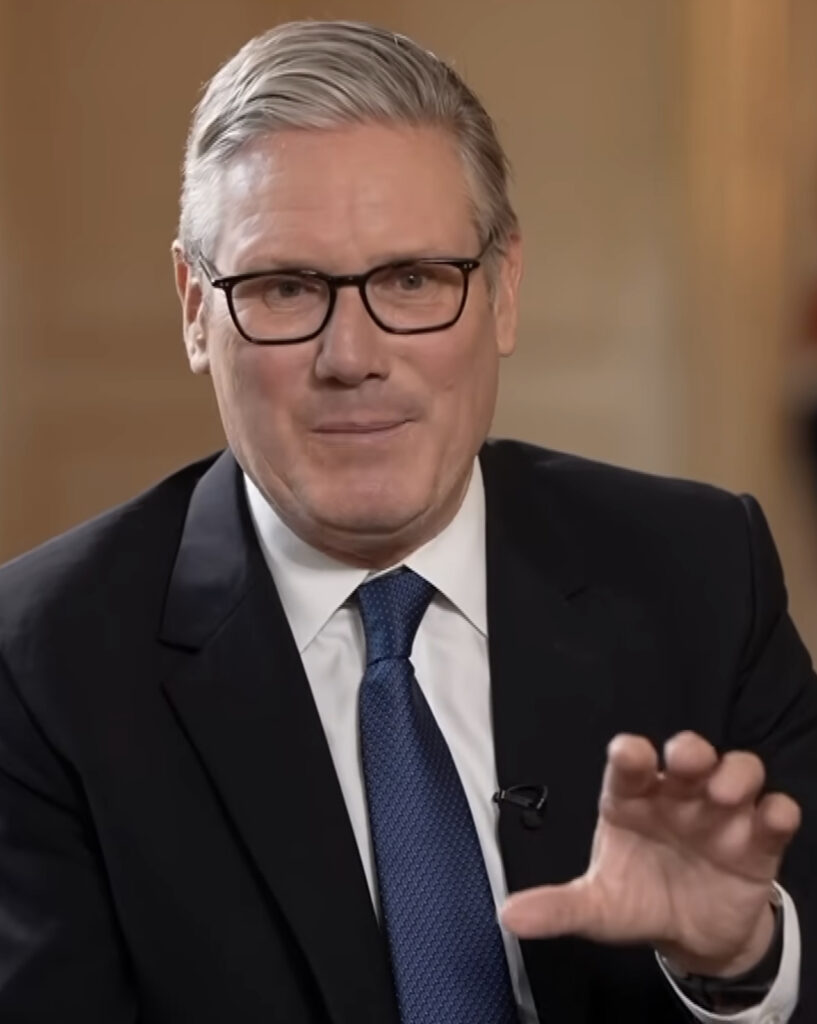
Amongst the Prime Minister’s interview gems:
“The first of those decisions was to increase Defence spending from 2.3% to 2.6% by 2027. That was a very important decision. That’s the biggest sustained increase in Defence spending since the 1980s. So, a very significant uplift in Defence spending.”
“That means we’re going to spend in this Parliament about £270bn on Defence. That is the biggest amount that has ever been spent.”
“The Strategic Defence Review that was carried out was intended to provide an answer to the capability within the 2.5% that we had risen to on Defence spending. When the Defence Investment Plan came back, it came with a much bigger price tag than that.”
“I, as Prime Minister have taken the decision to increase Defence spending in a way which has not been done since the 1980s, that is decisive.”
This desperate Prime Ministerial self-congratulation set TWOP off, dear reader, on a deeper analysis of UK defence spending, because John Healey’s disgruntled resignation immediately raises a more complicated and significant question: how much additional military capability is actually being delivered and how quickly?
October 2024 Budget (the first Labour Budget)
Baseline Plan
£bn 2024/5 2025/6
Resources 32.8 34.0
Capital 23.7 25.8
TOTAL 56.9 59.8
Prime Ministerial Statement 25th February 2025
Defence spending to be increased to 2.5% of GDP in 2027/8
Recharacterise UK Intelligence spend (SIA) increases total to 2.6% of GDP in 2027/8
Total Defence spending then to increase to 3.0% of GDP over next Parliament 2034/5.
25th March 2025 Spring Statement
Baseline Plan Plan
£bn 2024/5 2025/6 2026/7
Resources 34.8 37.6 39.0
Capital 19.1 22.7 23.2
TOTAL 53.9 60.3 62.2
26th November 2025 Budget
Outturn Plan Plan Plan
£bn 2024/5 2025/6 2026/7 2027/8
Resources 37.5 38.6 39.6 41.0
Capital 22.7 23.1 25.9 30.0
TOTAL 60.2 61.7 65.5 71.0
3rd March 2025 OBR Economic & Fiscal Outlook
The commitment to spend 3.5% of GDP on Defence by 2035 means spending on defence rises from 2.4% in 2025/6 to 3.0% by the end of the forecast. The total additional 1.1 % of GDP spending in 2034/5 would represent around £40bn in 2025/6 terms.
John Healey’s resignation demonstrates the widening gap between strategic rhetoric and delivery. MoD’s budgeting shows an additional spend of just £1.9bn (£61.7bn – £59.8bn) delivered in 2025/6 over the total envisaged in Labour’s first Budget in October 2024, but increases of £3.8bn in 2026/7 (£65.5bn-£61.7bn) and £5.5bn in 2027/8 (£71.0bn-£65.5bn).
However, the Defence Staff had been clear that the gap between current budget and the expectations set by 2025’s Strategic Defence Review amounted to no less than £28bn, whereas the Treasury proposal set out in the (still unpublished) DIP had originally been set at £18bn, but was clawed back down to £13bn, and thus £15bn short of MoD’s ability to deliver the capability increase set out as the target of the SDR (James Landale, BBC News, 12th June 2026, “Defence row exposes tensions over how to keep UK safe.”)
The result? Healey’s resignation and the Prime Minister’s subsequent panicked insistence that he has made “the decision to increase Defence spending in a way which has not been done since the 1980s.” The Prime Minister’s point is mathematically correct, but politically unsustainable and thus, within a week of Makerfield: PANIC.
The unformed “metric” in voters’ minds sets the difficulties Sir Keir has encountered in trying to deliver the £28.0bn additional costs of defence set out by the SDR against the apparent ease of delivering £28.5bn of extra spending for Pensions and Benefits over the (probable) course of the Labour Government between 2025/5 and 2028/9:
2024/5 2025/6 2026/7 2027/8 2028/9
Pensions & Welfare £bn 331.5 339.6 352.8 356.1 360.0
Source: Benefit expenditure and caseload tables 2026, 14th April 2026.
The Politics of Disorder
Events in North Belfast demonstrated once again how quickly local incidents can be absorbed into national political narratives.
Following the attack on Stephen Ogilvie by a Sudanese asylum seeker and the subsequent disorder that swept parts of Belfast, politicians rapidly returned to familiar arguments about immigration, asylum policy and social cohesion. The violence itself was condemnable. So too were the attacks on immigrant families and businesses that followed.
The more interesting political question is why these incidents resonate so strongly.
Part of the answer is that immigration has become one of the few issues through which wider frustrations are expressed. Concerns about housing, public services, community cohesion and government competence increasingly become folded into immigration debates whether directly relevant or not.
The result is a political environment in which every incident immediately becomes a proxy argument about the state of the country itself.
The Social Media Scramble
The Government’s emerging plans for a comprehensive social media ban for under-16s provide another example of politics operating at speed (or “at pace” as a gormless government minister would put it because they think that sounds better.)
The week commenced with “soft” releases of the Prime Minister’s intention to announce a more comprehensive social media ban for under-16s than had been expected previously in an attempt to set out a clearer agenda (or “legacy”!) before the Makerfield by-election on 18th June (Charles Hymas, Daily Telegraph, 8th June 2026 “Extend social media ban to 17 year olds”.)
This comes hard on the heels of the announcement on 8th June at London Tech Week that the government would demand that tech companies would prevent children (or more accurately children’s devices) taking, sharing, viewing, or storing naked images,
The consultation on children’s use of social media concluded only weeks ago. Existing Online Safety Act protections have only recently begun to take effect. Evidence from Australia remains mixed. Yet ministers appear increasingly attracted to a much more expansive intervention.
The concern is not necessarily the policy itself. Reasonable people can disagree about where the balance should lie between child protection and personal freedom. Ironically, the concern is, in fact, the process. Faced with mounting anxiety about children’s mental health, online harms and screen addiction, governments face enormous pressure to be seen to be acting. The temptation to act is a classic Consequence Affirmation Error:
– Something must be done.
– This is something.
– Therefore, we must do it.
History suggests that such reasoning should be approached cautiously:
– If an animal is a dog, then it has four legs.
– My cat has four legs.
– Therefore, my cat is a dog.
Makerfield and the Panic Index
As polling day approaches, Westminster has become so convinced that Makerfield matters that it has largely stopped asking why.
The constituency has become a vessel into which politicians, journalists and commentators are pouring their preferred political narratives. Labour sees a verdict on Starmer. Reform sees a verdict on its viability as a governing force. Labour’s leadership hopefuls see a verdict on the future direction of the centre-left.
Voters may be answering a rather different question. Recent polling suggests a significant divide between attitudes towards Andy Burnham and attitudes towards Labour itself that suggest that Burnham is personally overcoming wider loss of trust, in Labour’s ability to deliver its electoral promises.
The latest Makerfield opinion poll released by Opinium on 13th June show Burnham polling at 46% against Kenyon on 41%, with Restore’s Rebecca Shepherd on a more than victory-winning margin of 7%.
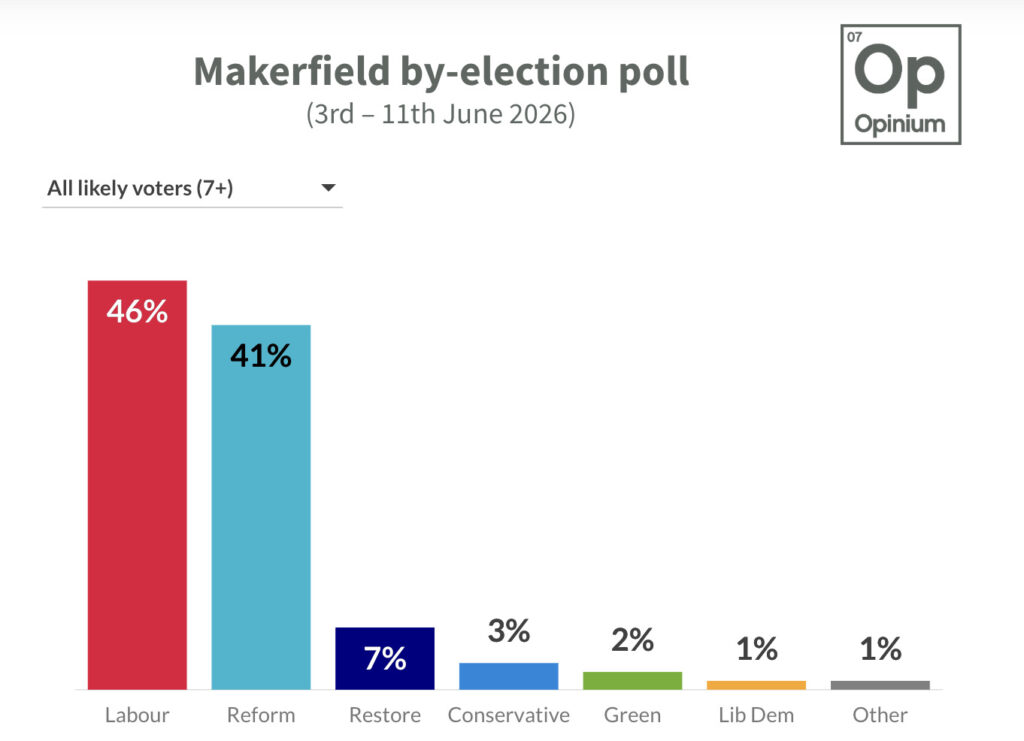
However, asking the same people their voting intention if they were going to vote in a General Election elicits the response that 42% would vote Reform UK compared with 34% for Labour. Labour’s question therefore must be whether the King of the North’s local appeal stands any chance of bolstering Labour’s possible General Election chances against Reform in 2029. Should Burnham be installed as Prime Minister in time for October’s Labour Party Conference, that leaves only two years for him to turn Labour’s lost trust around. It seems a tall order.
The irony is that the people most interested in Makerfield are not talking about the same issues as the people actually voting there, but by Thursday evening the result will be presented as evidence for dozens of competing theories. Some may even, eventually become true, but likely for reasons quite different to those imagined by Makerfield.
The Leadership Question
Running beneath all of these stories is a common theme: confidence (or lack thereof.)
The Defence Secretary’s resignation raises questions about the Government’s capacity to deliver its own strategic objectives. The Belfast disorder reflects wider anxieties about social cohesion and immigration. The social media debate reveals ministers searching for visible solutions to difficult problems. The Makerfield by-election has become a proxy battle over Labour’s future.
The common thread is not policy but confidence.
– Confidence in institutions.
– Confidence in leadership.
– Confidence that governments can still solve problems.
Politics becomes difficult when governments face crises but crises become really dangerous when governments start to react to every issue as though it is a crisis. That is the politics of panic and that is where the good if under-funded ship of state now finds itself.
Check us out on insta @theworldofukpolitics
Leave a Reply
You must be logged in to post a comment.