
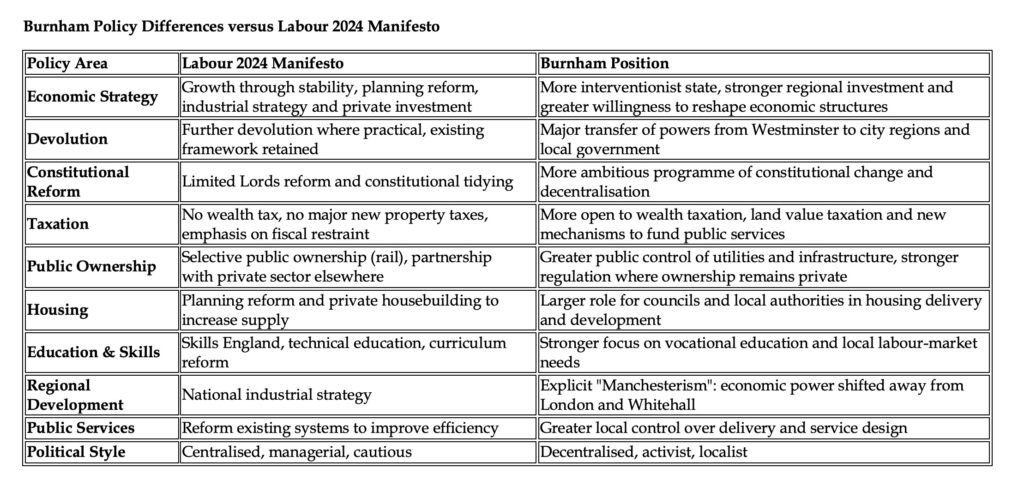
In the course of campaigning for Makersfield Burnham announced that if he displaces Starmer to become PM he would remain bound by Labour’s 2024 manifesto, but his “Manchesterism” has featured a stronger inclination to state intervention than the Starmer-Reeves positioning.
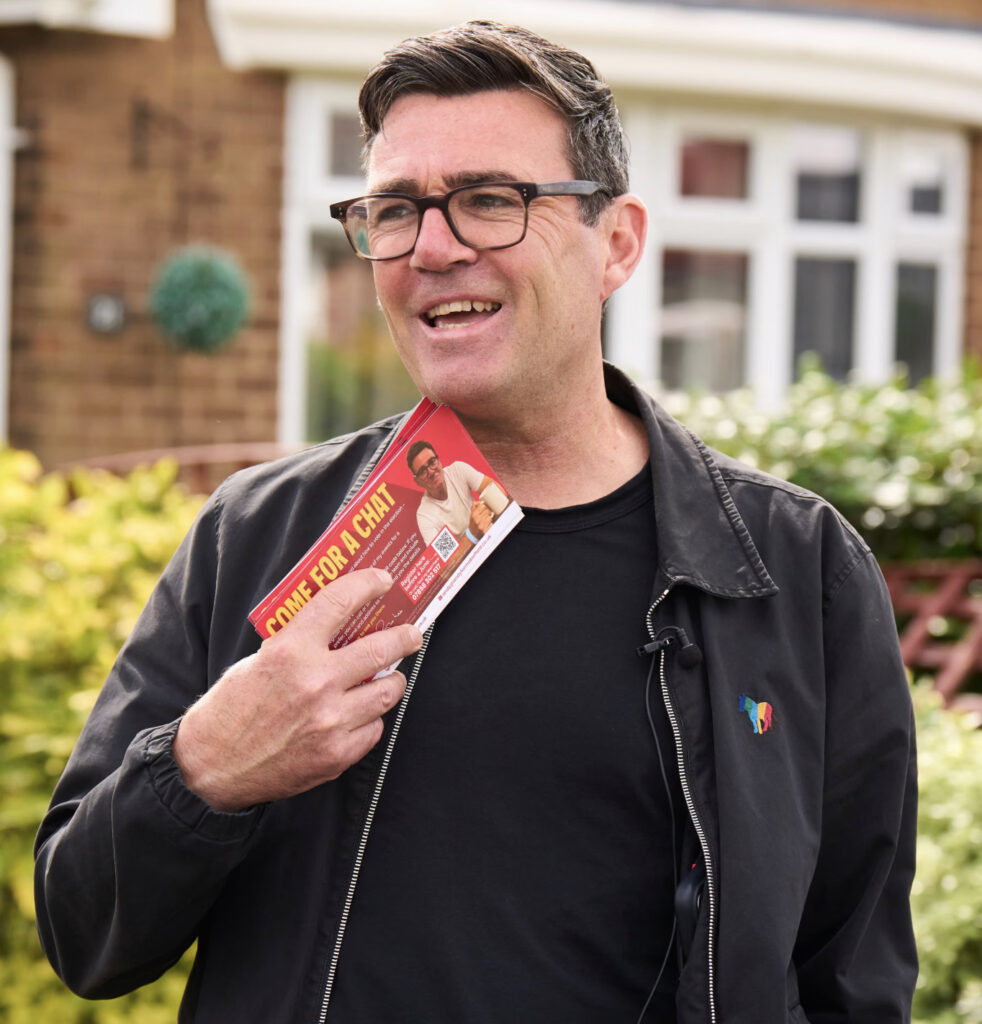
Burnham’s platform relies on Manchester’s relative success under his mayoralty (2017-’26.) Supporters argue that the region’s integrated transport strategy and housing initiatives have demonstrated that local government can deliver outcomes that Westminster struggles to implement. Critics counter that Manchester’s success predated Burnham’s election and owes more to long-term public-private partnerships and business investment.
Meanwhile many “emblematic” Burnham promises have not been achieved and some fairly disastrous policy failures have been clocked up:
– commitment to end rough sleeping “in a year” has never been close to being achieved
– promise to increase amount of new affordable housing schemes went seriously off-course
– an incomprehensible U-Turn on a clear air scheme that was developed and then cancelled
– ineffective and inappropriately structured inquiries in to the grooming/rape gang crisis.
Burnham’s significance lies not only in his popularity, but in the fact that he appears to have developed a different diagnosis of Britain’s problems from Starmer’s Labour. While the current government has largely sought to improve the performance of existing institutions, Burnham’s approach is more structural. He is more willing to redistribute power away from Westminster, reform ownership models and intervene directly where he believes markets have failed to deliver.
In this mixed context of “achievement”, TWOP sets out the major differences Burnham has now said that he would try to implement as Prime Minister, if selected.
Defence Spending
In a by-election interview Burnham “accepted that there was a link between high spending on welfare and the lack of money for defence, but argued that the two could be reconciled.” While regretting that Healey and Carns had resigned over the proposed DIP funding settlement, it sounds as if Burnham will continue to try to fudge and delay increasing Defence spending. (Steven Swinford, Oliver Wright & Larisa Brown, The Times [paywall], 12th June 2026 “Andy Burnham piles pressure on Keir Starmer in defence cash row.”)
Taxation
To soothe bond markets and having requested advice from former Goldman Sachs sage and crossbencher, Lord O’Neill of Gatley, Burnham has explicitly recommitted to the 2024 Labour manifesto pledge not to raise income tax, VAT, or National Insurance rates. He has also suggested that he would not unpick the pensions “triple lock” so the death spiral continues, but…
Council Tax vs Land Value Tax
Burnham wants to replace Council Tax and Stamp Duties with a progressive Land Value Tax and refresh the long-outdated 1991 VOA land valuations which absurdly still define Council Tax property banding. Burnham seems to favour a 0.4% tax on updated property values as espoused by campaign group Fairer Share.
Inheritance Tax vs Care Levy
Burnham proposes abolishing death duties completely and replacing them with a flat-rate “national care levy” to fund social care, an idea that he has pursued somewhat ineffectually since 2009. The details of a “Care Levy” to be charged on property values replacing Inheritance Tax could be said to require further work to make it a practical policy initiative (Pippa Crerar, The Guardian, 4th June 2026 “I wouldn’t flinch: Burnham on social care”) but the willingness to take on the social care issue is a flourish of optimism.
Wealth and Business Tax
Burnham suggests that he would be keen to introduce a wealth tax in part to fund cutting business rates by 20% for pubs, music venues and small independent businesses. Although Burnham (and Streeting) have tried to avoid specific proposals for a wealth tax that could easily spook financial markets, discussions seem to gravitate towards a 2% tax on the value of assets over £100m. (Philip Inman, The Guardian 12th June 2026 “The case for Labour to introduce a wealth tax has never been stronger.”) Is that the cabin door of the superyacht one hears banging?
Fiscal Drag Mitigation
Burnham is opposed to continuing the freeze on income tax thresholds (“fiscal drag”) so as to avoid increasing the number of lower-income pensioners brought in to the income tax net. (The i Paper [paywall], 14th June 2026 “I’ll keep the triple lock, and give pensioners a tax cut.”)
Constitutional Reform
Burnham continues to favour the introduction of Proportional Representation (PR) for general elections to combat political apathy and adapt to a multi-party landscape (The Observer, 31st May 2026 “I am committed to proportional representation.”) Traditionally this logic is overcome once candidates obtain power under FPTP, but if Burnham vaults in to No 10 without the tedious necessity of an election perhaps his enthusiasm for PR will remain undimmed.
House of Lords
In government Labour has removed the remaining hereditary peers but continued to appoint droves of failed mid-level politicians to the Upper House. Burnham advocates slashing the total number of peers and shifting to an “indirect election” model linked to general elections.
“I wouldn’t rule out quite an early change, and possibly the 2029 general election or beyond, because I’ve long believed that there’s a first stage of Lords reform, which is indirect election that could be linked to a general election, and I just think we can’t delay this any longer.”
Andy Burnham, The House via Politics Home, 5th June 2026.
Three cheers from TWOP if so – although this whole interim indirect election in 2029 seems unwieldy: just go straight to a 100-member Senate elected by PR right away. Job done.
Public Ownership
Labour’s 2024 manifesto took a measured approach to public ownership (mostly focusing on rail via Great British Railways) so as to avoid spooking the markets, but Burnham calls for all utilities to be brought under public ownership or, failing that, much heavier regulation (Kiran Stacy, The Guardian, 13th June 2026 “Public control of water and energy at heart of Burnham agenda.”)
Higher Education
The 2024 manifesto defended the existing tuition fee structure while reforming repayments. Burnham has been a long-term (2015…) supporter of a Graduate Tax replacing loans to fund tuition fees. More recently Burnham has outlined an intent to overhaul higher education funding, having labelled current tuition fees a “millstone of debt” that creates intergenerational unfairness, while suggesting that the structural obsession with university for all is inappropriate. Nevertheless as a Cambridge graduate (Eng Lit, Fitwilliam, 1988-’91) Burnham is unlikely to tear up the varisty rulebook completely.
Devolution
While the 2024 manifesto offered further local mayoral devolution, Burnham has demanded full devolution of Department for Work and Pensions (DWP) budgets to create local “Live Well” services, aiming to give English regions the same powers as the devolved governments of Scotland and Wales. His appearance at Cambridge’s Bennett School of Public Policy in March 2026 suggested that a lot of Burnham’s thinking is driven (haha) by his experience of bringing bus services in Manchester back in to public ownership and there are significant structural questions to answer before his enthusiasm for the devolution of more powers to local government could be implemented.
Housing
Labour’s 2024 manifesto relied on private developers meeting planning targets, but Burnham has argued for aggressive state intervention, including a radical scaling up of direct council house building alongside the introduction of a “Good Landlord Charter” that would enable renters to require legally enforceable property checks. His enthusiasm for directly funded social housing seems to know no bounds (Simon Cairns, The Negotiator, 22nd May 2026 “Andy Burnham sets out his vision for housing.”)
No doubt, now Makerfield is won, there will be a host of policy clarifications, but the bones are clear:
– more nationalisation and public control
– more directly funded social housing
– proportional representation and House of Lords reform
– devolving more powers away from Westminster to local government
– a wealth tax, a care levy, harmonisation of income and capital taxes, abolition of inheritance tax and stamp duties.
BUT
– a very similar fudge on defence spending to Starmer’s avoidance/delay
– a rather half-hearted acceptance of Shabana Mahmood’s immigration reforms (partic retroactive Indefinite Leave to Remain qualificiation changes)
– a somewhat confused stance on transgender rights, with initial support for self-identification reversed in favour of new EHRC guidelines following the Supreme Court’s April 2025 ruling.
Whether Burnham’s prescriptions will prove more successful than Starmer’s is impossible to know. The significance of Makerfield is that voters are increasingly interested in hearing them.
For now, Burnham has become MP for Makerfield. Whether he becomes Prime Minister remains uncertain. What is certain is that Labour now contains two increasingly distinct visions of how Britain should be governed. The contest between these contrasting visions has only just begun.
Check us out on insta @theworldofukpolitics
Leave a Reply
You must be logged in to post a comment.