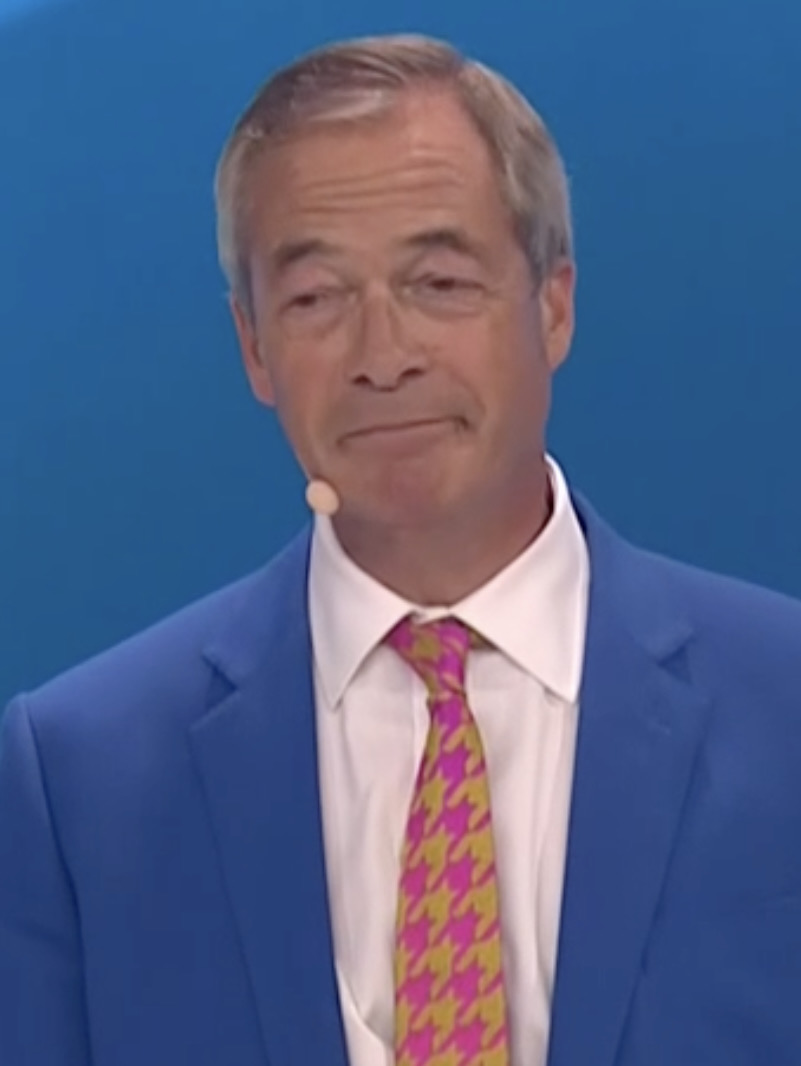
Nigel Farage’s much delayed conference speech was polished, combative and politically effective. It also exposed Reform’s central problem: the leader increasingly looks ready for an election, while the circle around him still does not look even close to being ready for government.

Farage warned his supporters that he expects an election next year. That remains TWOP’s view too, although this may be a coincidence based on entirely different reasoning. The leader’s arrival was repeatedly delayed for security reasons and his speech was then interrupted by hecklers four or five times. He dealt with them well enough, even if chanting “Boring, boring” orchestrated via onstage TV screens, became more than slightly boring itself.
The more serious interruption had arrived the night before. Channel 4 News’s undercover footage of two senior Reform figures appeared to discuss ways of disguising the foreign source of political funding. Both aides have now stepped down while the party investigates. Farage called the operation a stage-managed entrapment by climate campaigners, insisted that Reform had broken no law and conceded only that his aides’ remarks had been injudicious “loose pub talk” while reiterating (by ostentatiously returning to his script) that Reform “takes compliance seriously.”
As damage limitation, this worked. Farage acknowledged the story, gave the faithful an enemy to blame and moved on before the allegations could consume the whole speech. It did not answer the questions raised by the footage, but it supplied supporters with sufficient reason not to ask them.
Against signage promising “The First 100 Days” Farage presented Reform’s programme as a burst of impatient activity, but with anger toned down from Zia levels. A Reform government would:
- stop the boats within 100 days: “End of”
- reduce welfare spending by £50bn
- cut taxes on working people “in a radical way” (TM hope over experience)
- cut household energy bills by ¬£250 and “end the net zero lunacy”
- train enough British nurses and doctors for the NHS
- prevent British and foreign courts and judges obstructing government policy.
The language was expansive, the policy offer rather less so. Cutting £50bn from welfare is a large promise, but modest beside Reform’s broader claims about the savings available from government. A £250 reduction in energy bills would be welcome, but is scarcely revolutionary. Training more doctors and nurses is unobjectionable, but it is an ambition rather than a plan until Reform explains who will train them and how long it will take.
The gap was to be filled by willpower. Reform’s attitude, Farage said, is “can do and will do.” Dear Leader promised to declare a national emergency and, if necessary, make Parliament sit for 24 hours a day, 6 days a week, until the required legislation had passed. If the Lords resisted, Reform would appoint hundreds of peers to push legislation through and, if that failed, the chamber’s future would be put to a referendum (expecting the answer “abolition.”)
This is potent campaign rhetoric. It is also an unlikely prospectus for competent government. Parliament can sit through the night, but exhausted legislators do not make difficult Bills any simpler. Hundreds of new peers might overcome one obstruction while undermining Reform’s promise to clean up Westminster. Declaring an emergency can accelerate legislation, but it cannot train a doctor, build administrative capacity, or make an uncosted Budget pledge miraculously add up.
The speech ended suddenly, perhaps because the security delays and interruptions had forced it to be truncated. There was no great climax or repetition of its central pledges. But Farage had achieved his immediate purpose: what began as a conference overshadowed by questions about Reform’s fundraising ended, at least inside the hall, with the audience once again talking about Nigel.

Slightly underwhelming rhetorically and distinctly underwhelming in policy terms, it was nevertheless a successful exercise in political control. Farage demonstrated once again that he knows how to command a room, deflect an attack and keep true believers in a frenzied state of adulation. What Nige did not demonstrate was why a prospective Prime Minister repeatedly surrounds himself with hopeless toffs as aides whose carelessness creates precisely the distractions he is frustrated by having to overcome.

Are Reform ready for government? Farage hoped delegates would leave Birmingham with an emphatic “Yes!” His own performance moved the party a little closer. The unimpressive policies, the constitutional bravado and the conduct of those around him pulled it back again. The answer therefore only remains: “Perhaps” but as before, this indecisive conclusion is still mainly because of Nigel and increasingly despite his closest acolytes.
Leave a Reply
You must be logged in to post a comment.