The End is Nigh.
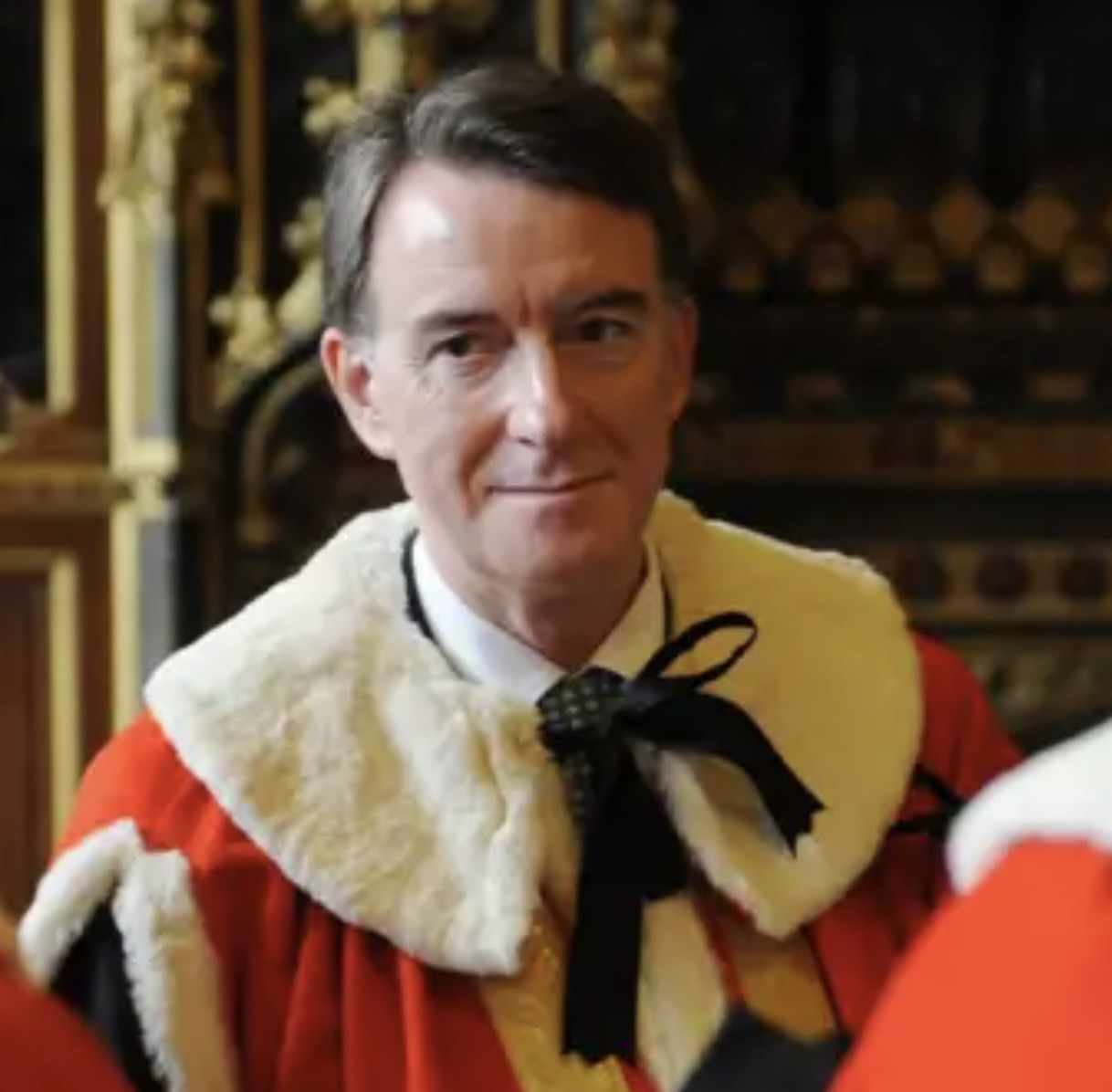
Peter Mandelson’s Washington appointment was always a high wire act. It was sold as hard nosed realpolitik: a seasoned operator, a serious network, a Labour government signalling competence to the White House and Wall Street. However, the appointment contained a basic miscalculation of the post-2020 political climate: voters tolerate many things, but they can not abide the sense that the rules are different for the well connected and they have a visceral hatred for anything adjacent to child abuse.
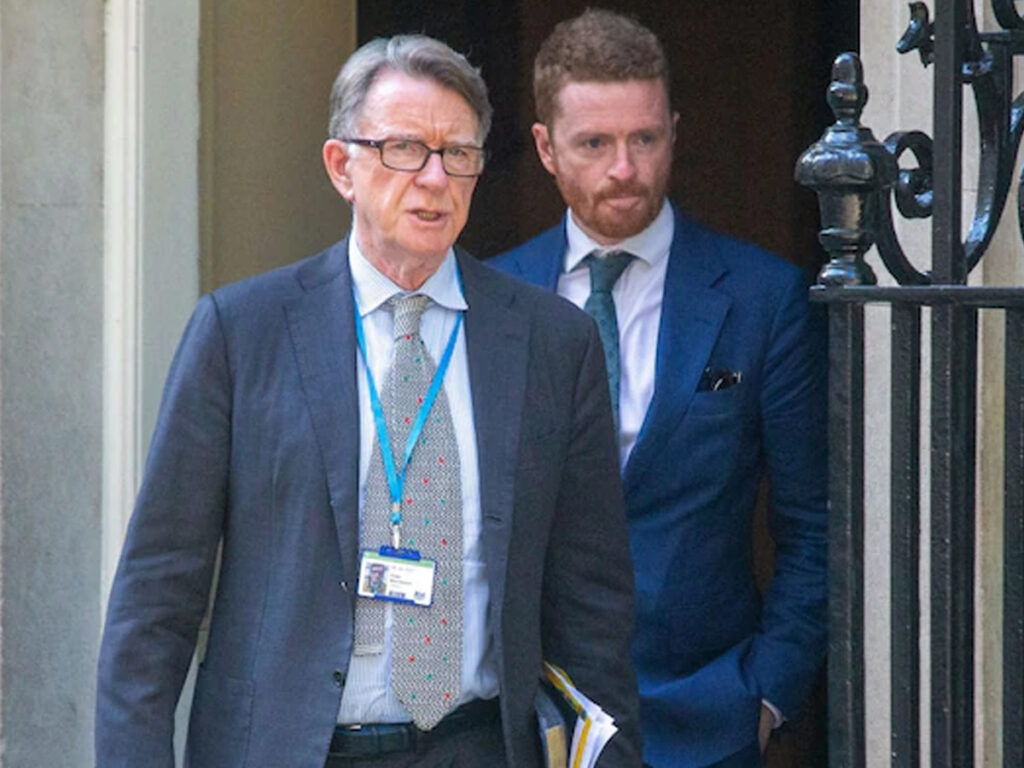
The renewed scrutiny of Mandelson’s relationship with Epstein detonated that misread. The details that surfaced, including Mandelson sharing market sensitive information derived from his Cabinet position directly with Epstein, have been presented as the sort of establishment rot that never really left. The Met confirmed that it had started an investigation and although that could provide some excuse for delaying document releases it will also keep the whole story alive potentially for a very long time indeed. The investigation is bound to spill over to include Andrew Mountbatten-Windsor to the toe-curling embarrassment of Buckingham and Kensington Palaces.
Associated Press framed this very simply: a senior appointment made despite known reputational risk, followed by a resignation at the heart of Downing Street when the risk became reality (Jill Lawless, Associated Press, 8th February 2026, “UK leader’s chief of staff quits over appointment of Mandelson as ambassador despite Epstein ties.”) TWOP goes further: Mandelson’s appointment was not made despite the risk, but because of the attraction of inserting an interlocutor in to the White House with significant overlap with Trumpian interests, history and blindspots.
This may provide the unique opportunity to deploy a quotation from French philosopher, Albert Camus: “Dans ce grand temple déserté par les dieux, toutes mes idoles ont des pieds d’argile” which we might translate as “In this great temple now deserted by the gods, all my idols have feet of clay.” (Translated, probably eclectically, by yours truly, from Camus’ essay “Le Désert” from “Noces”, 1938.) Mandelson was appointed BECAUSE he had obvious feet of clay and with the hope that he would play footsie with all the White House folk with similar podiatric issues.
The resignation that explains everything and solves nothing
Morgan McSweeney’s resignation is being treated in some quarters as the honourable circuit breaker. He supported his friend and mentor’s appointment and he has now fallen on his sword. The Guardian report captures the choreography: he takes “full responsibility”, Starmer praises his service, deputies step in, the PM promises to review vetting “procedures.” (Pippa Crerar, Sunday Guardian, 8th February 2026, “Morgan McSweeney resigns as Keir Starmer’s chief of staff.”)

Resignations only work when they close the argument. This resignation reopens it all.The real question is not whether McSweeney gave the advice, it is why Starmer wanted to hear it.
The Mandelson appointment sits in a pattern that opponents inside and outside Labour have been describing for months: a leadership style that prioritises control, message discipline and the soothing aesthetics of competence, but strategically avoids action and takes too many chances on the very thing that corrodes competence: the insider shortcut.
Starmer’s going to criticise Boris for appointing mates? One thinks not.
If you think the public are angry about outcomes, you offer policy. If you think the public are angry about process, you offer ethics. If you think the public are angry about both, you do not bring back the most symbolically loaded operator of the New Labour era, into a role that depends on credibility.
McSweeney’s exit therefore reads less like a clean reset and more like a confession: the Starmer project has been run by a small circle with a taste for “clever” moves and a tolerance for reputational risk, until the risk turns into a headline that will not die.
Mandelson was always going to be a Starmer problem
There is also a structural reason this catastrophe became inevitable: Mandelson is not just a person, he is a signal. He signals a return to a specific political tradition, managerial, technocratic, elite-networked and largely unembarrassed about the lobby shaped ecosystem around it. That tradition can win elections, but it bleeds legitimacy fast when the country is primed to interpret power as self-dealing.
So the moment the Epstein material moved from background association to document driven controversy, the government had no safe options. Defend Mandelson and you validate the charge of “one rule”. Distance yourself and you concede that the initial judgement was flawed. Quietly remove him and you invite the question: why was he there in the first place and who signed off the risk?
The payoff angle has stuck. The politics are obvious: a story about judgement becomes a story about entitlement. The Telegraph reported an exit payment in the range of roughly three months’ salary, which gives critics a neat line, consequences for them, austerity for you. (Ben Riley Smith, The Daily Telegraph, 7th February 2026: “Mandelson told to hand back ‘five figure’ payoff he received after being sacked as US ambassador.”)
Vetting, judgement, and the illusion of containment
Downing Street will now talk about process. Starmer always does. He will promise stronger vetting and clearer guardrails. McSweeney himself is reported to have called for an overhaul (too little, too late, Ed.) Vetting failures become leadership failures when they are not random. This one was not random.
The Epstein connection was not an obscure detail requiring forensic digging. It was exactly the kind of reputational landmine that even moderately attentive politicos knew would come back, because the political incentives guarantee that it will. Opponents will always return to it. The Press will always re-examine it on slow news Thursdays in August. Backbenchers will always leak about it when they are annoyed about not being made some Mandelson protégé’s PPS.
So if the government says the problem was insufficient vetting, critics will answer: the problem was that you believed you could manage your way out of the narrative and so the Mandelson saga will now be used as a proxy for a wider argument about “Starmerism” in as much as that exists. A project built on centralised control and risk-managed optics, operating in an era where control is brittle and optics collapse at the speed of a document dump.
The McSweeney coda that makes this worse, not better
A second McSweeney story this week landed unhelpfully on the same pressure point. Labour Together, the think tank McSweeney used to run (Aletha Adu, The Guardian, 27th October 2023: “Eyes on the prize: thinktank that put Keir Starmer and Labour on front foot”) has been accused of paying a “PR” firm (APCO Worldwide) to investigate journalists and identify sources behind stories about its failure to register £730,000 of funding. That allegation reinforces the critique that the Starmer operation treats scrutiny as a hostile act to be managed, rather than a democratic function to be respected. Peter Geoghan, Democracy for Sale, 5th February 2026: “McSweeney’s think tank paid PR firm to investigate journalists.”)
Even if the government’s line is that this is separate, the political effect is cumulative: Mandelson says elite impunity, the payoff says self protection, and the think tank allegations say machine politics. Together, they create a picture that is very difficult to bleach out with a reshuffle and a new comms line.
Is Starmer’s fall now in sight?
Politically, the direction of travel is now easy to see. Labour have been in free-fall since coming in to power in July 2024. Continued descent will hand government to REFORM UK, a prospect sufficiently galling to make many on the left think seriously about jumping ship to the Greens. The Conservatives have had a good Mandelson: Badenoch skewered Starmer with impressive ruthlessness in the Commons, while Reform have been blah in parliamentary terms… (as, in fact, REFORM usually are: the do not have sufficient members in the House or the high-calibre support staff for the preparation and organisation required for an effective public knifing in the House.)
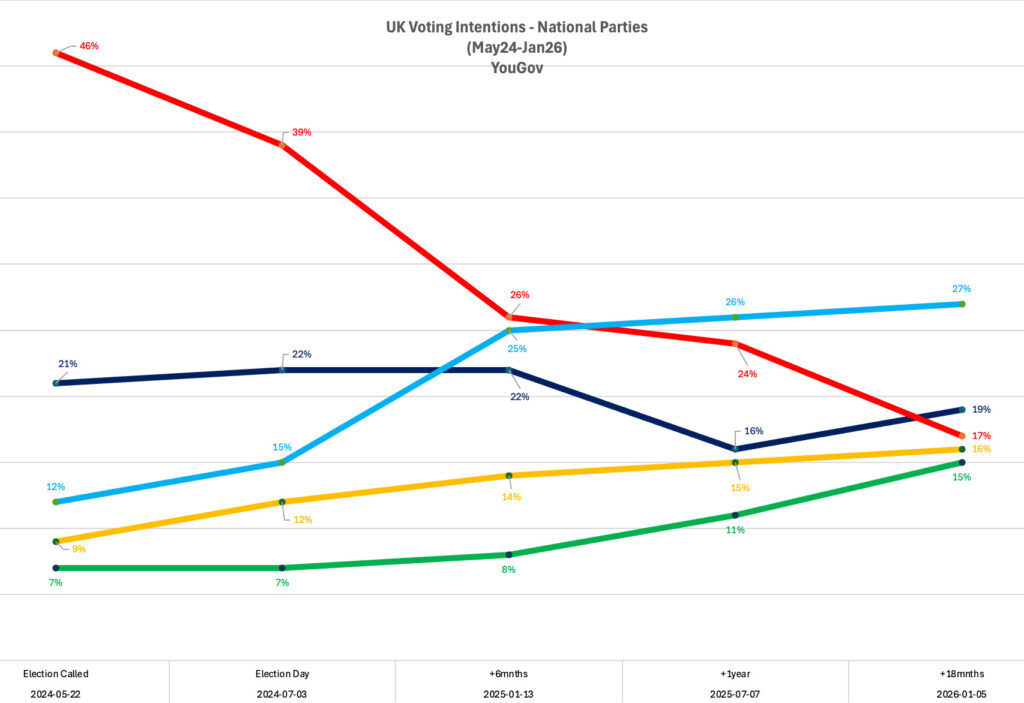
Starmer’s authority depends on an implicit promise: boring competence, cleaner standards, fewer self inflicted dramas. Mandelson was the opposite of that promise. McSweeney’s resignation does not remove the contradiction, it highlights it.
The next phase is predictable in the way Westminster is always predictable. The party will brief that the crisis has been contained. The opposition will say the Prime Minister must go. The civil service will quietly tighten procedures. The public will roll their eyes. Then one of two things happens. Either Starmer resigns in the face of growing backbench incredulity or McSweeney’s resignation will give Starmer a week to lance the plotters’ boil by demanding early expressions of fealty. If he manages that the PM will be relatively safe until May’s elections which will kick off a more concerted (Streeting-initiated) coup with Rayner the likeliest winner.
However, the alternatives to Starmer are all worse than unpalatable:
Burnham – blocked by Starmer’s NEC
Rayner – under HMRC investigtion
Streeting – Mandelson protégé
Milliband – idiot
YouGov’s ranking of Labour Leaders’ popularity suggests a run-off between Lord Blunkett and Ken Livingstone would best serve Labour members’ interests. Give me strength.
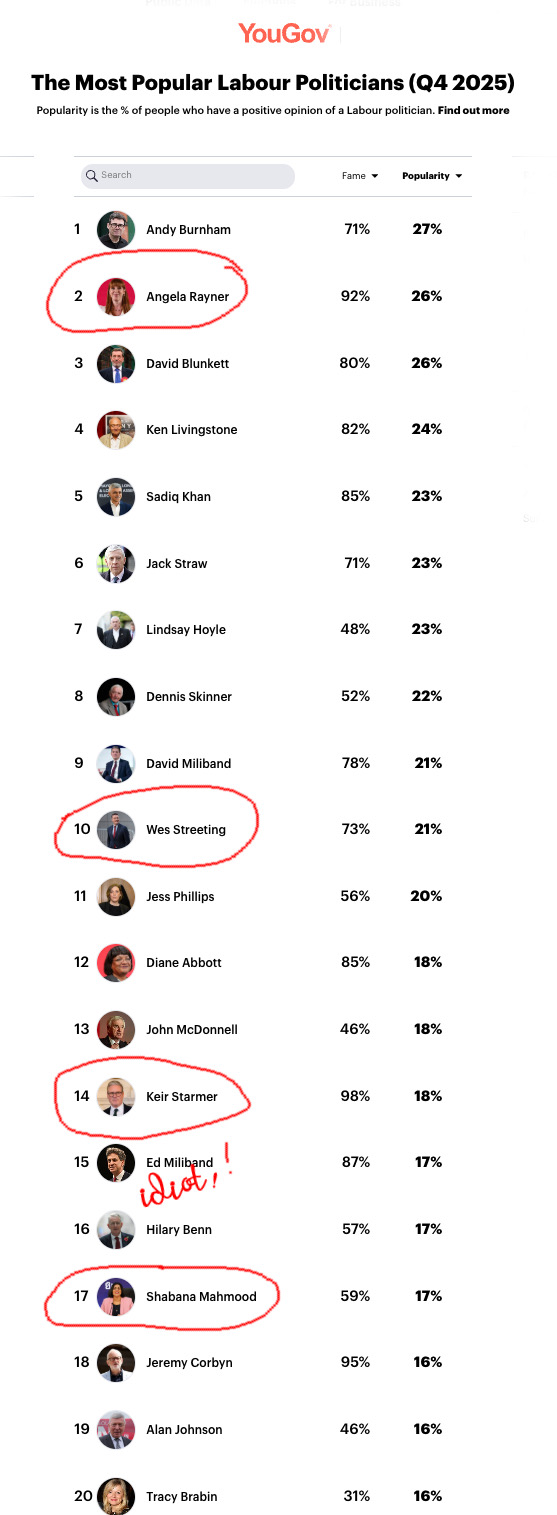
So, having bought 7 days’ grace with the sacrifice of McSweeney, Starmer must now seek a path to saving himself from Wes Streeting’s plan to unseat him before the local elections (or those of them that remain as yet uncancelled.) One imagines that there may be a growing tide of “stories” reminding Labour members and particularly constituency parties, of how very “close” to Mandelson Streeting was. Oh Wes! If Starmer forces Cabinet public expressions of loyalty in the coming week he will hang on until the (dire, obvs) results of the local elections on 7th May, now just three months away. Is it possible that HMRC’s investigation of Rayner’s failure to pay the correct rate of Stamp Duty on her holiday home purchase might come back with the totally unexpected news that although Ms Rayner may be a couple of slices short of a loaf, she wasn’t actually intending to do anything actually immoral by the first week of May? If so, then our Ange may press the button rather than Wesley.
A new Prime Minister should celebrate the second anniversary of Labour’s “ascent” to Government on 7th July 2026. All that “Change” Starmer promised in 2024? Not so much.
Check us out on insta @theworldofukpolitics
Leave a Reply